Thanks for visiting! This site has moved to fearlessdream.us, where all new posts will appear! Please update your bookmarks accordigly.

The new feed URL is: http://fearlessdream.us/feed/

“The secret of happiness is freedom. The secret of freedom is courage.”
— Thucydides

“A civilization that feels guilty for everything it is and does will lack the energy and conviction to defend itself.”
— Jean-François Revel
Showing posts with label Europeanization. Show all posts

Where do we go now?

Monday, December 17, 2012

Given the way Bill Whittle’s extraordinary “Silent America” essays saved me from isolation and despair years ago, it should have come as no surprise that a series of new videos from Bill was the first thing that gave me any reason for hope after the re-election of Barack Obama in November. More than that even, Bill’s words and ideas in these videos made me feel unexpectedly energized about the prospect of a way forward. Watching them is no small time commitment, but neither is saving our beloved USA, and I can vouch for the fact that Bill doesn’t disappoint. His sober but undaunted thinking seems like exactly what we need now.

I started with “A New Beginning…”, the November 7, 2012 episode of Bill’s semi-regular video podcast, “The Stratosphere Lounge”. In it, Bill advances a big-picture idea that looks beyond the process of politics-as-usual that has repeatedly failed us, to postulate a tectonic cultural shift that may now be possible: American citizens voluntarily contributing to the building of parellel private-sector institutions that will put their sclerotic, unsustainable government counterparts to shame by the comparison of results they produce. There’s more to it than that, and Bill explains and motivates his idea in much greater depth than I can hope to effectively summarize, so by all means give this a watch if you can.

Bill’s thinking seems to me to contain echoes of Virginia Postrel’s “Dynamism”, with a key idea being emphasis of decentralized, voluntary initiative in diverse and numerous laboratories of innovation over attempting to shape the future through rigid central planning.

The book Bill mentions in this video, “The Starfish and the Spider”, is available on Amazon, by the way.

If you might only find time to watch one of these videos, I’d probably suggest starting with “Where do we go now?”, Bill’s talk at the November 12, 2012 Hancock Park Patriots meeting, which is followed by an unmissable Q&A session (OK, OK, that makes two videos) in which Bill demonstrates how an effective President of the United States would handle key issues and address a press corps that actually did its job and asked tough questions:

As I remarked and quasi-summarized in my Twitter timeline after watching “A New Beginning”:

Bill’s is a big dream, but dammit, everything worth having in this country was built by people who dreamed big. It can be done!

Focusing only on the next election is the trap we keep falling into; it’s how we keep losing ground. It’s the best our opponents can hope for. Progressives/Alinskyites have a long-term plan that has changed the culture over decades. That’s the game we need to play, but there’s more…

Our existing cultural institutions — education, entertainment, space exploration — are lost. They are tied to a sinking Leviathan of a state. Our only hope is to build voluntary parallel institutions that outshine them, that will show by comparison what miserable failures they are.

The good news: Culture leads; government only very slowly reacts and follows and struggles clumsily to adapt.

Our present centralized government is born of the Industrial Revolution, a by-gone age. It’s unlikely to survive the next big paradigm shift. It’s ossified, rigid, slow-moving, and economically unsustainable. The future requires dynamism, adaptability, decentralization.

Progressivism’s idea of “Forward” is the dinosaur in the room. It’s rigid, coercive, glued to theory that doesn’t flex when reality defies it. Think of all the technological revolutions that have blindsided us in our lifetimes, that few saw coming, and the impact they’ve had. Things we’re incapable of planning for end up mattering the most. Progress is what happens while Progressives are busy making other plans.

Anticipating what might be the next wave is hard enough. Trying to engineer a rigidly defined future is a losing battle. Dynamism wins.

So many genuinely smart people know just enough to think they can engineer the world. If engineering has taught me anything, it’s humility. Solvable problems have to be very tightly constrained, conditions for solving them clearly defined. Reality can ruin your whole day.

We know what doesn’t work, or works clumsily at best and seems doomed to collapse under its own weight and inertia, but what’s the alternative? What are the practical mechanics of a way out? Building parallel private-sector institutions whose success puts their government rivals to shame.

The crux of Bill’s idea: Pay your taxes. Write that off as gone, lost. Forget it. Budget some of what’s left to help build something better.

It’s a grand and vague idea in some respects, but I do believe with the right approach this can work. Government can’t compete with private sector dynamism.

I stand by that assessment, and I have hope we’ll find that some variant of Bill’s ideas on this will provide a real and achievable way out. If you yearn to reclaim our future as I do, by all means please give Bill’s latest work a hearing.

So Long, California

Tuesday, September 4, 2012

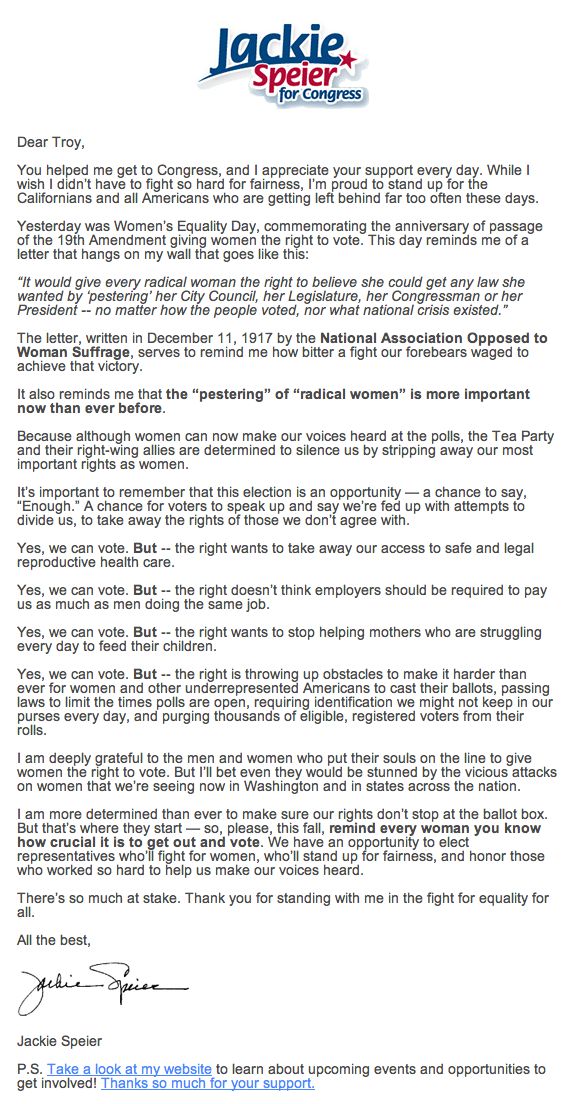
On receiving a campaign email titled “Every Radical Woman” last week from my former Congresswoman, Democrat Jackie Speier, whose mailing list seems to have mis-classified me as a supporter, I felt compelled to reply.

I suppose I might have saved my energy and let this one go — I no longer live in California, after all — but its cynical and disingenuous attempt to tar the pro-liberty Tea Party movement as somehow anti-woman, as part of the bombastic “war on women” meme that today’s Democrats seem to hope will distract from their out-of-control spending and abysmal failure on the economy, was too far beyond the pale to go unchallenged.

On a range of issues culminating in Speier’s enthusiastic support for the legislative and financial disaster known as ObamaCare, whose detractors her campaign vilified as fear-mongering extremists, I never felt Congresswoman Speier represented my positions or values. Thankfully, we are now both relieved of the representative-constituent relationship, as I explained in my emailed reply:

You may wish to update your contact list. I did not vote for you, but you may thank me for relieving you of the burden of representing me.

After 33 years in California, some of it lived as a moderate Democrat, I have given up on my beloved home state, and departed with my productivity and entrepreneurship in search of places where fiscal sanity is practiced. I have been much happier for it, and have not had cause to look back.

As one municipality after another goes bankrupt, while voters refuse to do the difficult grown-up work of reining in out-of-control spending, my only remaining hope for the state of my birth is that it may serve as a warning to the rest of the country before it is too late.

Suffrage was and remains a fine and just achievement, but it’s an irreversible milestone from which society has rightly moved on. Today’s authentically “radical women” are those who challenge the regnant orthodoxy of unsustainable, infantilizing nanny-state feminism and are routinely vilified for it. The overwrought notions that calling for fiscal responsibility somehow constitutes a “war on women”, or that the economy- and liberty-focused Tea Party represents a resurgence of anti-feminist social conservatism, are farcical and disingenuous scare tactics, and I suspect most of those who promulgate these desperate fallacies know that. If there is a war on women, it is nowhere more manifest than in persistent unemployment that disproportionately affects women -- the foreseeable result of decreasingly competitive, increasingly business-unfriendly economic policies. What will most help women is what will help us all: a return to smaller government and fiscal sustainability.

For my part, I’ve had enough of fiscal denial, and the ugly and cynical politics of fear, envy, and entitlement that have fed this crisis, having left in search of places where the pioneering American Idea still thrives. I will go wherever I have to to escape the ruinous advance of Progressivism -- a philosophy whose state mechanisms, as California’s 33rd governor aptly put it, resemble nothing so much as my newborn’s alimentary canal -- with an insatiable appetite at one end, and no sense of responsibility at the other.

I do hope California can be saved. I’m done waiting and wishing, against all evidence and common sense, for it to happen, and I leave the state to those who seem to think they know better.

You’re welcome.

Your Former Constituent,
Troy Stephens

A snapshot of the campaign email to which I replied:

'Every Radical Woman' Campaign Email, Received from Jackie Speier for Congress, 2012-08-27

Independence Day 2010

Sunday, July 4, 2010

In last year’s Independence Day post, I offered a playlist of my favorite Liberty-themed songs. This year, it’s going to be a brief, issue-focused post for me, as what I want most is to direct readers’ attention to a very important but uncertain new initiative:

Bill Whittle, PJTV commentator who first gained admiration and notoriety for his brilliant and eminently worthwhile “Silent America” Essays, has chosen July 4th, 2010 to launch “Declaration Entertainment”. By all means, watch this 4½-minute welcome video that explains what it’s all about:

See Bill’s 3-minute “Pioneers” video for more.

Pipe dream? Perhaps. Can it work? I honestly don’t know. But Bill has a plan, and he’s doing something, and while I hold out great hope that his idea will succeed tremendously, I greatly admire his initiative independent of the result. Because to me, this really matters.

Many of us have watched with increasing despair over the years, as the Hollywood we thought we knew growing up — one whose craft once promoted and unabashedly celebrated classically American values such as optimism, confidence, self-reliance, entrepreneurship, and heroism (including the heroism of American soldiers who risked everything fighting for the freedom of others) — has gradually transformed into the preeminent domestic broadcaster of anti-Americanism, social criticism, ambivalence, nihilism, and ennui. From the content it now produces to the invective its glitterati deliver from the pulpits of self-congratulatory awards ceremonies, Hollywood has mainstreamed the culture of shame, cynicism, social criticism, and self-loathing that was once largely the preoccupation of a small, bitter niche of radical-left academia.

Those of us who’ve felt this despair have realized that today’s Hollywood does not speak for us, our values, or our outlook. We’ve felt helpless to do anything but stop buying a product that routinely insults and vilifies us. Yet, for reasons that Declaration Entertainment’s introductory video explains, this strategy of passive withdrawal exerts no significant economic influence on the content that a now internationally-funded Hollywood produces, for what has become first and foremost a worldwide audience. I believe we’ll learn that it’s not enough to economically reject repellent content and its Hollywood creators. We ultimately need to find other ways of getting our own movies made, of producing and promoting alternative content that positively reflects our values and confidence in our culture.

Remember when School House Rock distilled the essence of the American Idea into educational and genuinely celebratory Saturday morning shorts such as “No More Kings”, “The Shot Heard Round the World”, “Elbow Room”, “The Preamble”, “Sufferin’ ‘til Suffrage”, and “Fireworks”? Watch them again (or most anything else of that era), with the eyes of 2010, and think long and hard about the tremendous change that’s occurred in our popular culture. Can you imagine educational shorts like these being produced and broadcast today? Why not? Would you ever, back in those days, have predicted such a transformation of attitudes?

It’s not supposed to be like this.

We have a choice.

If we care enough, we can usher in a new Renaissance of the American Idea.

Bill’s ambitious plan for “Declaration Entertainment” could, I sincerely hope, be the start of that.

Remember when we believed in us:

ps - Now that I’ve thoroughly depressed you: Go enjoy some uplifting music!

Frontiers

Friday, June 19, 2009

One nagging thought that’s troubled me for several years now has concerned the nature of “frontiers” — the character of those who strike out to populate them, what happens as the populace of a former frontier changes over time, and what to do when we run out of new frontiers to settle.

The United States began life as a frontier of far-flung colonies — colonies that came to be populated by people who were brave, bold, and/or desperate enough to give up every semblance of stability in their former lives and risk everything on the possibility of a new and, they hoped, better future on the other side of a formidable ocean — a future they knew full well they would have to fashion by their own exertions, at considerable risk, in a land of many unknowns.

Over the few centuries since, the US has become a new home to immigrants with similar circumstances, motivations, dreams, courage, and drive hailing from every reach of the planet. Many more who might have wished to begin new lives here, but were fearful of the risks this life entails, did not come, and in this way our melting-pot population became a self-selecting group largely characterized by a measure of boldness, guts, and — I dare say — genuine, honest-to-gosh audacity.

At the same time, of course, we’ve also set about increasing our ranks the old fashioned way. Those born here sometimes successfully absorb the spirit of the place, and grow up to share such courage, determination, independence, work ethic, and mettle as their immigrant ancestors bore. Others somehow don’t acquire these traits, and seeing as they’re already here, don’t have to get here, and typically stay, they end up edging our average bearings as a population a bit farther away from that rugged pioneer spirit.

Roughly speaking, then, relative rates of immigration and birth, coupled with our rate of success or failure at instilling a love of sweet Freedom in our newly minted Americans, combine to determine the vitality of the American Spirit. (I leave out emigration as a relatively insignificant contributing factor because — funny thing — that just doesn’t happen much here.)

This all leads me to a question that, to my scientifically-trained mind, is reminiscent of the grand cosmological question of whether we live in an “open” universe (one that will continue to expand without limit) or a “closed” universe (whose expansion will eventually be slowed and then reversed by mutual gravity, leading it to recollapse):

Does a frontier inevitably move?

Maybe the answer should be intuitively obvious. A frontier doesn’t stay a frontier forever. New places are discovered, and become the new frontiers, while the old, now-familiar places accumulate a sort of inertia and become stable.

Only, what happens when we run out of new places? What happens when the old, former frontiers become gradually less friendly to those who dare to dream the really big dreams, who aspire to wide-open unencumbered FREEDOM as far as the eye can see, but there’s nowhere else left for them to go?

Barring the discovery of an unforseen loophole in the laws of physics as we’ve thus far distilled them, we are prisoners of our own solar system, whose eight — er, strike that — seven other planets aren’t particularly hospitable to human habitation. At great cost and with enough of the hardy pioneer determination that birthed this nation it could be done, perhaps, but there is no other home remotely as cordial as this precious blue-green marble we inhabit within our grasp. Firefly fantasies aside, enterprising interplanetary homesteaders don’t have a whole lot of choices — or, really, any — right now.

This fact has been keenly on my mind as we watch our beloved United States of America become seemingly less and less recognizable to those of us who prize untrammeled individual freedom as the Founders did. As our population gradually loses that once-indomitable frontier spirit, and in the place of cherishing Sweet Liberty increasingly demands the safety, security, and closing of material equality gaps that are promised by a culture of regulation, entitlement, and coerced redistribution, so our dear country begins to seem less and less the kind of place for an intrepid frontiersman or frontierswoman to hitch their wagon to.

Perhaps the strangest thing of all about this “Europeanization” of America is the insistence on implementing such ideas here, despite the litany of nations in which they are already practiced (a fact it seems we’re incessantly reminded of by domestic critics of the classically American Way of life — you know, the ones who insist that Swedes, Venezuelans, and Cubans are somehow “freer than we are”). “Diversity” is not so much to be sought and celebrated, it seems, when it comes to socioeconomic policy — at least when doing so favors the continued existence of classically liberal (economically permissive rather than socially engineered) societies. Oddly, though the United States places no restrictions on emigration, proponents of Europeanization rarely seem to choose that route to obtaining the lifestyle they favor. There is something about this drive that seeks to transcend personal choice and impose that choice on others (ostensibly for their own good, of course).

Maybe the subduing of America is a “Holy Grail” of sorts for those who aspire to bring the benefits of benevolent statism to the whole world. Transnationalism has been a key aspect of Marxism from the get-go, and some ideas die hard. Today’s transnational progressivism, with its contempt for and active attempts to undermine international tax and regulatory competition, seems little different in this respect. Transnationalism seeks to seal off all avenues of escape for those who crave and seek greater economic freedom and commensurate responsibility for assuming risk. There would be no way out in a future world that agrees on and enforces the same set of laws, taxes and restrictions everywhere. The message from control-hungry transnationalists is clear: Tough luck, buddy. One Vorld Government vill be gut, und you vill like it.

If even the fiery, fiercely independent souls who inhabit the United States can be berated into giving up Liberty for safety, superficial equality, “fairness”, “niceness”, or just to be like everyone else, then there is truly no limit to statism’s ability to dominate a willing, submissive, or even just indifferent humankind. If we choose — on a personal, individual and not just national level — to continually seek the approval of others in an exceedingly self-conscious high-schoolish popularity contest, in the place of cherishing our right to scandalize the neighbors, then we are as good as done, and the American Idea is dead — much to the delight of its very vocal detractors.


Take a good look at the following piece of contemporary art, which I took notice of among the 2008 “Zero1” exhibits in San Jose. Study it until you see the message behind the message.

Going Out of Business?

In the final year of the Bush administration, this was shown as mockery and criticism of America’s conduct in waging the Global War on Terror, from the perspective of the sort of person who thinks we ought to be ashamed of ourselves rather than fiercely proud and doggedly committed to our nation’s defense in the wake of the 9/11 Jihadist attacks on US soil. The longer I studied this image, the more the eagle’s tear rang hollow. Is the artist’s intent really to express regret at the decline in opinions of America that he or she obviously feels is justified?

I think there’s a clear second meaning here, that’s picked up by those who go in for such stuff, and it is one of triumphant celebration. There are people — the artist included, I strongly suspect — who could not be more pleased by this development, who don’t merely feel ashamed of what they think we’ve become, but cannot stand even what we once were and have long stood for, and who cannot wait for the American Idea itself — the notion of your life on your terms — to fall in the world’s esteem, lose its luster and appeal, and fade away as an object of aspiration for millions upon millions the world over. They want mindshare for governing ideas of their own, and those ideas have little to do with freedom I’m afraid.

Friends, it’s no accident that the tongue-in-cheek “fire sale” that this exhibit advertised accepts “Euros or Mao Bucks”:

Get your Euros and Mao Bucks ready, comrade!

"Department of Homeland Graffiti": Oh how clever

Why is it that we keep seeing these folks among the ranks of anti-war activists? It’s hard to avoid supposing that they are more accurately pro-war, but on the other side.

Look at the image again.

Going Out of Business?

It is not a lament, but a victory banner. Those it speaks for feign disappointment, but in truth couldn’t be more pleased. America and what she represents falling in the world’s esteem. Mission Accomplished.

These fellow citizens and others like them aim to demoralize us with their moralizing — to tame, subdue, and crush the defiantly independent frontier spirit that makes us us — and I fear they may be succeeding.


How we got to this point from our ruggedly independent, defiantly freedom-loving, living-my-own-way who-cares-what-others-think frontier roots is a very long story. But the net change in our national character could hardly be more pronounced.

Living in the far-West former frontier “Gold Rush” state of California as I do, I feel acutely aware of the especially radical transformation my state has undergone since its settlement — crossing the full spectrum from initially wild and lawless open country to one of the most social-engineering-heavy and burdensomely taxed and regulated (or, if you prefer, most “progressive”) states in the Union. To some, this is desirable progress. To me, it is the slow, tragic dying of a cherished dream and ideal.

Western Star

When I contemplate the Frontier, the “Invocation” of Stephen Vincent Benét’s epic poem “Western Star”, which I first mentioned a few years ago, always comes to mind. I’ve read this passage at home in far-West California; I’ve read it on vacation on a horse ranch in Wyoming, a state whose wide-open vistas preserve some of the last remaining fragments of the old frontier spirit. And it gives me a deep shiver. Every time.

Not for the great, not for the marvelous,
Not for the barren husbands of the gold;
Not for the arrowmakers of the soul,
Wasted with truth, the star-regarding wise;
Not even for the few
Who would not be the hunter nor the prey,
Who stood between the eater and the meat,
The wilderness saints, the guiltless, the absolved,
Born out of Time, the seekers of the balm
Where the green grass grows from the broken heart;
But for all these, the nameless, numberless
Seed of the field, the mortal wood and earth
Hewn for the clearing, trampled for the floor,
Uprooted and cast out upon the stone
From Jamestown to Benicia.
This is their song, this is their testament,
Carved to their likeness, speaking in their tongue
And branded with the iron of their star.
I say you shall remember them. I say
When the night has fallen on your loneliness
And the deep wood beyond the ruined wall
Seems to step forward swiftly with the dusk,
You shall remember them. You shall not see
Water or wheat or axe-mark on the tree
And not remember them.
You shall not win without remembering them,
For they won every shadow of the moon,
All the vast shadows, and you shall not lose
Without a dark remembrance of their loss
For they lost all and none remembered them.

Hear the wind
Blow through the buffalo-grass
Blow over wild-grape and brier.
This was frontier, and this,
And this, your house, was frontier.
There were footprints upon the hill
And men lie buried under,
Tamers of earth and rivers.
They died at the end of labor,
Forgotten is the name.

Now, in full summer, by the Eastern shore,
Between the seamark and the roads going West,
I call two oceans to remember them.
I fill the hollow darkness with their names.

Is it possible to read the above and not feel it in your bones?

The Frontier lives on in Wyoming


All this has been on my mind for a seemingly very long time now, but it took this superb blog post by “VodkaPundit” Stephen Green to prompt me to finally compose my thoughts.

American freedom was a huge, sprawling, messy, brawling thing. It consumed everything and anything, and spewed out an unimaginable bounty. For some, the freedom was about growing their business and making money. For others, it was about growing their hair and making love. But it was always here, for anyone willing to risk the journey and leave behind the Old World and its old ways.

But now that we have this wonderful place, this precious idea — what are we doing with it?

Already, the government runs our children’s education and our parents’ retirement. Now we’re allowing it to usurp our banks and nationalize what remains of our auto industries. Within weeks, Washington promises a plan to dictate our health care. To do all this, we’ve let Washington run up enough red ink to impoverish our grandchildren. As if all that weren’t enough, the president still found the time to kick our friends in London and Tel Aviv while courting a genocidal, election-stealing maniac in Tehran. He even gave a speech in Cairo — that oppressed, impoverished Old World megalopolis — in which he assured the world that America really is no better than anywhere else.

Well, once upon a time, we were.

Absent a warp drive, a wormhole, or some other science fiction escape to an uninhabited Earth-like planet, it’s impossible to recreate the conditions which allowed the creation of these United States. It can’t be done; there aren’t any New Worlds left to discover. Our maps are all filled in.

If the Old World comes here, where does the New World have left to go?

When the Puritans were persecuted in England, they risked everything to come to America. When young Germans faced the Prussian army’s grip, they gave up their ancient towns to come here. When Jews faced the Czar’s pogroms, they gave up their bucolic steppes for the slums of New York. Rather than accept stagnant lives in their own countries, Latin Americans risked uncertain lives in America. Rather than accept far milder impositions than our own, America’s Founding Fathers risked their lives, their fortunes, and their sacred honor just to sign their names on parchment.

Anyone with nothing to lose and everything to gain — and bearing wits and character enough to risk it all — came here. They ventured here. To America.

Whatever liberty we have right here, right now, in America … well, for all practical purposes, that’s all that’s left anywhere. If France had our freedoms, there would be no French here. If China had it, there would be no Chinese here. If it existed in Latin America, there would be no Spanish spoken here. And so it goes.

And so if we, here in America, throw it all away in a fit of panic or pique, then what we once called “America” will become as false as a fairy tale.

By all means, read the whole, brilliantly worded thing.


One more thought in closing:

Remember the 2004 and 2008 presidential elections, when many on the left threatened to “seek asylum” in Canada if Bush or McCain won?

Those of us who cherish the classically American commitment to individual Freedom have no Canada. America is our last, best hope. Our opponents know it. And if we lose this ground for good, it seems to me we will have lost everything that matters.

For the sake of all we hold dear in this life, we mustn’t let that happen.
Another Call for World Government

Tuesday, December 9, 2008

Via Drudge: Gideon Rachman in the London Financial Times (emphasis mine):

Even in the EU – the heartland of law-based international government – the idea remains unpopular. The EU has suffered a series of humiliating defeats in referendums, when plans for “ever closer union” have been referred to the voters. In general, the Union has progressed fastest when far-reaching deals have been agreed by technocrats and politicians – and then pushed through without direct reference to the voters. International governance tends to be effective, only when it is anti-democratic.

And yet, the author seems nonetheless to favor the idea, both throughout the article and in his closing:

The world’s most pressing political problems may indeed be international in nature, but the average citizen’s political identity remains stubbornly local. Until somebody cracks this problem, that plan for world government may have to stay locked away in a safe at the UN.

Pesky, provincial voters! Where is their vision? Clearly there’s a need for someone to “crack this problem”. The will of the unwashed masses can’t possibly be allowed to stand in the way of global progress.

The most frightening thing about the idea of a single world government is precisely what gives it such appeal to those who would see themselves in positions of power within it: There is no escape (short of a rocket ride to an as-yet-nonexistent off-Earth colony, and who knows even then what the governing arrangement with the mother planet will be?). Don’t like the regulatory climate, taxation scheme, or laws abridging free speech or free exercise of religion where you are? Tough. That’s the way it will be, everywhere.

"What I Saw at the Obama Revolution"

Thursday, November 6, 2008

Rick Moran at PJM:

I suppose I got caught up in the emotion of the night due almost exclusively to the genuine and copious tears of black Americans. The ones I spoke to and interviewed were nearly speechless with joy. With a start, I realized something that had escaped me all these long months of writing and thinking about this race. For many African-Americans, this election was a spiritual event, something that transcended the corporeal and brought to mind ancestral yearnings and desires for freedom.

For perhaps many blacks, Obama is the word made flesh — the redemption of the promise in the Declaration of Independence that “all men are created equal.” The small sample of blacks I interviewed all spoke of the shattering of barriers, the hope that an Obama presidency would translate into a more just society, and the belief that for them personally, their lives would never be the same.

It struck me then and now that the world has turned upside down. When I was a boy, a black man could not get a sandwich at a lunch counter in much of the country. Now a black man has been elected president of the United States, receiving more votes from whites than his predecessor of 2004.

Commenter “portia9” cautions poignantly:

Where I come from, no matter how smart you are, no matter how hard you work you are extremely unlikely to ever achieve the kind of success that is available to citizens of the U.S. If by some unbelievable stroke of fortune you do achieve it, you will be taxed very heavily, penalized really, for your efforts. There is no can-do spirit. There is nothing like the “American Dream” because that dream exists nowhere but here.

Everything that I have learned about President Elect Obama leads me to believe that he does not cherish the American Dream. He does not believe in it, although, ironically, he is a prime beneficiary of it. He would rather remake this country in the image of those his friends and allies like William Ayers cherish. Socialist countries. Communist countries.

In the decade I have lived here, I have come to realize just how precious the much maligned “American Dream” really is. I was taught as a university student in Canada that it is a fiction, but I have learned through living here that it is real. Socialism is not the answer for this country. America has made a devastating choice this election. I only hope that he will not be able to change this country so much that it will be unrecognizable in four years.

I hope that Obama’s actual performance in office won’t merit these fears, but I fear portia9’s concerns are well-founded.

Obama: is America ready for this dangerous left winger?

Sunday, February 24, 2008

Gerard Baker at the UK Times Online:

In what might be the most revealing statement made by any political figure so far in this campaign season, Mrs Obama caused a stir this week. She said that the success of her husband Barack's campaign had marked the first time in her adult life that she had felt pride in her country.

...

It was instructive for two reasons. First, it reinforced the growing sense of unease that even some Obama supporters have felt about the increasingly messianic nature of the candidate's campaign. There's always been a Second Coming quality about Mr Obama's rhetoric. The claim that his electoral successes in places like Nebraska and Wisconsin might transcend all that America has achieved in its history can only add to that worry.

Secondly, and more importantly, I suspect it reveals much about what the Obama family really thinks about the kind of nation that America is. Mrs Obama is surely not alone in thinking not very much about what America has been or done in the past quarter century or more. In fact, it is a trope of the left wing of the Democratic party that America has been a pretty wretched sort of place.

There is a caste of left-wing Americans who wish essentially and in all honesty that their country was much more like France. They wish it had much higher levels of taxation and government intervention, that it had much higher levels of welfare, that it did not have such a “militaristic” approach to foreign policy. Above all, that its national goals were dictated, not by the dreadful halfwits who inhabit godforsaken places like Kansas and Mississippi, but by the counsels of the United Nations.

Sounds like pretty scary stuff to me -- yet seemingly equally apt as a description of the views of and aspirations for the U.S. that Hillary Clinton has expressed. Whether it's Mrs. Clinton or Mr. Obama, it appears that the Democratic party will be putting forth a socialist candidate for the office of President of the United States this time around.

I try to reassure myself that freedom-loving Americans of once hardy, pioneering stock would never actually elect a candidate of this sort, who runs on a platform of seeming shame about who we are, and a vision-less vision of making us more humble and obedient like everybody else. But the mere possibility is certainly enough to give me a chill...