Thanks for visiting! This site has moved to fearlessdream.us, where all new posts will appear! Please update your bookmarks accordigly.

The new feed URL is: http://fearlessdream.us/feed/

“The secret of happiness is freedom. The secret of freedom is courage.”
— Thucydides

“A civilization that feels guilty for everything it is and does will lack the energy and conviction to defend itself.”
— Jean-François Revel
Showing posts with label Sharia. Show all posts

American Islamic Group Supports Sharia Law Ban

Tuesday, September 13, 2011

There are non-trivial legal and freedom issues involved in considering such a measure, of course, but the fact that there are Muslims in the United States advocating for a ban on the implementation of Sharia law here, as described in this article on The Blaze, gives me hope. From the “American Islamic Leadership Coalition“‘s website:

As American Muslims, we believe that the law should treat people of all faiths equally, while protecting Muslims and non-Muslims alike from extremist attempts to use the legal instrument of shari‘ah (also known as Islamic jurisprudence, or fiqh) to incubate, within the West, a highly politicized and dangerous understanding of Islam that is generally known as “Islamism,” or “radical Islam.”

As American Muslims we are conscious of the fact that Muslim Brotherhood legacy groups and other Islamists and their surrogates in the U.S. are trying their best to portray any opposition to manifestations of shari‘ah law as “racism” and “discrimination against Muslims.” However, as a coalition of traditional, liberal and secular Muslim Americans, we denounce this fear-mongering and playing of the race card, which only serves to mask the Islamists’ highly politicized agenda.

“Many of us fled the Muslim world to escape Shariah law… We do not wish these laws to follow us here.”

More from groups like this, please.

A Plea, Ten Years After: Please, Open Your Eyes

Saturday, September 10, 2011

In past years, I’ve written about where I was on 9/11, posted quotes, written about songs, tweeted the names of victims, and recommended blog posts, articles, and videos. But on nearly every anniversary of the 9/11 al Qaeda attacks since I started blogging, the unifying issue on my mind has been nearly the same: To assess where we are and how we are faring some years after.

Reviewing what I’ve written in years past, I find that my answer to that question has changed very little, and the farther we get from that awful day the more that fact worries me, for despite having successfully thwarted at least 19 subsequent would-be attacks, I don’t think we’re faring very well as a culture, in crucial ways that for me raise serious questions about what our long-term future will hold.

I try not to let the gloom envelop me. In so many ways, I am an optimist in my heart of hearts. I have tremendous confidence in our culture and way of life, in our resilience and adaptability, and in all that we can achieve with our ingenuity and dedication and mutual goodwill. Yet it kills me to see that same culture mired in and hobbled by an unwarranted mentality of self-recrimination and self-doubt, and simultaneously unwilling to candidly examine and confront an ideological movement that is actively, deeply, vocally, immutably, and demonstratedly hostile to its foundational principles and continued existence.

What does it mean to live in a culture that is only just barely willing to stand up and fight for itself in the wake of a horrific act of war such as the 9/11 attacks? I would not have thought our present-day frame of mind possible to sustain after such an event, but the cultural and political divisions that predated 9/11 have proven far more resilient than I would ever have expected. We didn’t wake from our slumber of infighting to pursue, united and with doggedly committed determination, the defense and preservation our nation and way of life; rather, we retrenched and resumed fighting each other, our cultural fault lines painfully underscored in the process. As Michele Catalano wrote three years ago,

In so many ways, 9/11 ended up furthering any divisions we had instead of closing them. We chose up sides and backed away from each other as if we were our own enemies —- as if the enemies we had, those who steered planes into buildings, weren’t enough.

This realization, and the seeming impossibility of bridging the chasm, has been a knife in my heart ever since. It kills me. But I don’t see any way around it.

So many aspects of our cultural condition have caused me grief over the past ten years. I feel crestfallen that it is taking us as long as it has to rebuild at the World Trade Center site. I’ve felt deeply betrayed by a Hollywood that now routinely denigrates and vilifies the country whose values and achievements it once celebrated and defended, a Hollywood that I loved in my youth but have now all but written off and given up on. I have been deeply disappointed in a supposedly mainstream American press that seems to have seen it as its sworn duty to demoralize us and convince us of inevitable defeat and dishonor in the wars we’ve prosecuted, in a way that’s been shown to be transparently contingent on the political party of the President in the White House. I’m troubled that over the past three years, we’ve largely acted in ways that can only serve to embolden our enemies, while giving our friends and allies and those we should at least be lending moral support in their fight for freedom and against totalitarianism (c.f. Iran’s democracy activists, and other participants in the recent “Arab Spring” uprisings) scant reason to hope for the backing of a country that has for so long been thought of as a beacon of hope and the moral “leader of the free world”. It makes my heart sink that too many of our own citizens seem to believe that America is the problem in some form or other.

All of these cultural factors pain me and deeply trouble me, but on this 10th anniversary of the 9/11 attacks I’m willing to largely put them aside in the interest of getting just one, crucial point across regarding the single most dangerous problem we face: the inability or unwillingness to name, frankly discuss, and squarely face our ideological enemy. More than anything else, it is a commitment to reckoning with this circumstance that needs to cross the perhaps otherwise impassable ideological chasm that separates the American Right and Left.

We can and will continue to differ with our countrymen regarding specific policy prescriptions, including matters of war. I could perhaps accept that, in a world where I felt we had all made a candid and fully informed assessment of the adversary we are up against. But there are still many among us who don’t seem to want to look Islamic Supremacism in the face, or even acknowledge its existence, either because the prospect is too frightening, or because the acknowledgment would violate long-practiced “PC” rules of cultural conduct that are so deeply ingrained in us, we fear we wouldn’t know how to function without blindly deferring to them. If I could make one plea to my fellow countrymen, Left, Right, and Center, it would be this: Please, please look with open eyes at what we are up against. Even if you must conclude that Islamic Supremacism is a fringe ideology with no real possibility of gaining dominance or causing substantial long-term harm to the free world (I truly wish I could believe it was so), do so with a full understanding and awareness of what the Jihadists intend for us, far-fetched or not, as detailed in their own words and actions: the return of a 7th century Caliphate that is fundamentally incompatible with and hostile to secular and pluralistic free societies, with all the attendant implications for women, homosexuals, infidels and religious and ethnic minorities. These Jihadists have told us their intentions time and time again, but we somehow refuse to believe them.
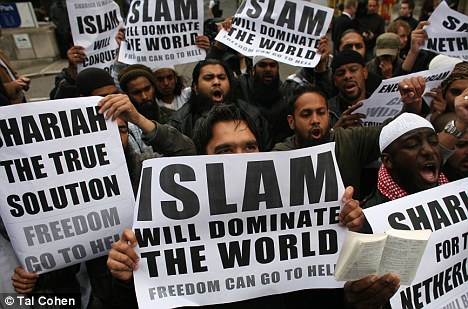
We are so conditioned to reflexively genuflect to any and every other culture as a show of goodwill, that both our critical thinking faculties, and our courage to overcome fear of social reprisals and voice our honest concerns, seem to have become disengaged or defunct. If every culture and religion in this world was as benign in its intentions toward us as most are, this willful blindness wouldn’t be a big problem. We could all live together in happy harmony and the “coexistence” that so many understandably wish for. But the fact that most others have relatively benign intentions has disarmed us to the crucial few that do not. Our cultural defenses are down — way down — and even being caught off our guard ten years ago with horrific consequences doesn’t seem to have changed that sufficiently. Informing and educating ourselves about what we’re up against is crucial, for we cannot expect to remain both ignorant and free.

Is this state of denial (or leaning strongly toward diplomatic use of language, if you prefer) causing any real problems? It certainly seems to be. How else could a man like Nidal Malik Hasan remain in active service in the United States Army, after repeatedly making statements against the United States and in sympathy with our Jihadist enemies? There are compelling and deeply troubling indications that not only our armed forces, but our broader defense and law enforcement agencies are compromised in their ability and sworn duty to protect this country and its citizens by pressure to whitewash reality, sanitize the use of language that could be perceived as hurtful or offensive, and shrink from confronting reality. We are letting organizations such as CAIR — a front for the Muslim Brotherhood, whose charter calls for a “grand jihad in eliminating and destroying the Western civilization from within and ‘sabotaging’ their miserable house by their hands and the hands of the believers so that it is eliminated and God’s religion is made victorious over all other religions”advise our FBI on how to combat violent Islamic radicalism.

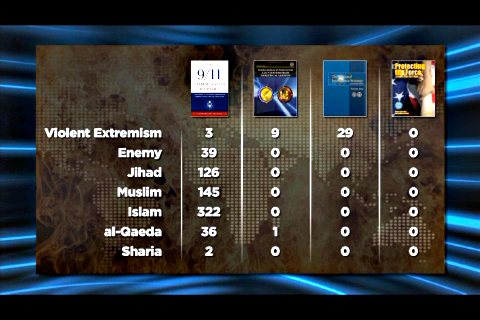
Bill Whittle’s April 7, 2010 PJTV piece “The Censorship Agenda” revealed in worrisome detail the sanitizing of our foundational national security documents that has taken place since the original, bipartisan 9/11 Commission Report. (As Bill himself suggests, contrary to the provocative subtitle “Obama Bans ‘Islam’”, the culture of self-censorship and willful blindness that produced these results may very well be indicative of a long-extant problem that predates the Obama administration.)

Think about the implications of Bill’s findings: in stark contrast with the comparatively frank and sober assessment of the 9/11 Commission Report (whose use of key terms is tabulated in the leftmost column, below), the FBI’s 2008 Counterterrorism Analytical Lexicon (next column), our 2009 National Intelligence Strategy report (next column), and the Protecting the Force: Lessons from Fort Hood report on the shooting rampage by Nidal Malik Hasan (rightmost column), use the terms “Islam”, “Muslim”, and “Jihad” a total of zero times.

Zero.

The National Intelligence Strategy report doesn’t even reference “al Qaeda” or use the word “enemy” (employing, instead, the term “violent extremist”, a total of 29 times). The DoD’s Fort Hood report, amazingly, makes no reference whatsoever to “violent extremism”, “Islam”, “Muslim”, “Jihad”, or even to Hasan’s name.

Think about this. Disregard, for the moment, our popular culture and variously informed conversation among Joes like you and me. How is it possible that the very institutions we charge with our defense — whose analyses one would expect, of necessity, to be unflinchingly sober and frank — have become this willfully blind?

I can only shake my head in near-despair at the self-sabotaging ridiculousness of it. It might be funny if the consequences weren’t so dire for all of us. (Bill, however, has a more upbeat outlook than I do this year.)

Forget about applying the non-lethal (but awfully emotionally insensitive) tool of humor by mocking our enemies, which appears to be completely out of the question save for a few valiant out-of-the-mainstream efforts such as Shire Network News and Sands of Passion. In most cases, we can’t even bring ourselves to precisely and candidly refer to them. If our thinking and definitions are clear, there should be no reason not to do so, given all that is at stake.

This man has the right idea (emphasis mine):

There is nothing insulting to decent, good members of the Muslim religion when I say “Islamic extremist terrorist”, any more than it is insulting to the Italian-American community (when I was a prosecutor) to say the word “Mafia”. Or that it would be insulting to decent Germans to say the word “Nazi”.

One mistake to avoid is political correctness. You can’t fight crime, and you can’t deter terrorism, if you are hobbled by political correctness. I believe that Major [Nidal] Hasan is an example of that. There is no way that Major Hasan should have been a major in the United States Army, after several years of spewing forth hatred for the United States of America… I would consider Major Hasan’s attack on Fort Hood an Islamic extremist terrorist attack. I have a hard time understanding why the government doesn’t see it that way, since he was yelling “Allahu Akbar” when he started killing people. …

… We cannot use this as an opportunity to say, “let’s put this behind us”, because if we we do that, we will repeat the mistake that we made before September 11th, which is not evaluating correctly the scope and the danger of Islamic extremist terrorism. Notice I use those words and I use them often. I do because I have a simple belief: If you can’t face your enemy, you can’t defeat your enemy. If you can’t honestly describe your enemy, there are distortions in your policy decisions as a result of that.

Re-read that last part, and internalize the essential lesson: If we refuse the accurate use of words, we are sabotaging ourselves.

Since accusations of “Islamophobia”, etc. are now flung automatically against any who express concern about Islam’s militant political arm as exemplified by the likes of al Qaeda and Hamas, let me be as clear as it’s possible to be, knowing full well that “it is impossible to speak in such a way that one cannot be misunderstood” (or willfully misinterpreted): I really don’t want to spend my time writing and thinking about this stuff. I have no intrinsic need to gratify myself or feel superior by grinding ideological axes against either an external enemy culture or my own countrymen. I’d much rather invest my time and energy inventing, innovating, creating, raising my son, spending time with my wife, living and working and striving to do better among peers whose origins span the globe, but who share a necessary basic dedication to the essential principles of a free society. I would love nothing more than to be decisively proven wrong about all of this, and get back to my life. I think and write about this kind of stuff because, as far as I can tell, there is no avoiding it. The very culture that furnishes and protects my ability and yours to live our lives as we do and freely engage in such humanity-advancing work, is under attack by another that demands our submission to a suffocating, stifling, totalitarian ideology. If we cannot name, discuss, and confront that ideology, we might as well surrender to it.

My “endgame” — the long-term future I hope for — is not a perpetual state of war (who would wish for that?), but a true coexistence of stable peace and security that can only exist after the Islamic Supremacist threat has been acknowledged and somehow neutralized. That is to say, I seek a peace worth having. To whatever extent we can accomplish that without resorting to the use of force and violence, wonderful — you have me on your side. I want and hope for a future where I can freely live, work, and prosper alongside all others who share my commitment to upholding the essential principles of our free society, Muslim and non-Muslim alike, regardless of where on the globe they hail from, without any of us having to fear violence from totalitarian nutjobs. There is too much to do and achieve for us to waste our time, capabilities, and resources on war where we have a reasonable alternative. But to shrink from the last-resort necessity of war when it is upon us seems to me no less a betrayal of the society we rightly cherish, for if left undefended that society will crumble.

I speak “peace”, when peace is spoken.

Even when we are not in our worst moments of genuflecting self-censorship, our choice of terminology has been clumsy, muddled, and unhelpful from the start — and, make no mistake, these poor choices of terminology sink us. Case in point: A “War on Terror” is no more meaningful than a “War on Blitzkrieg”, or a “War on Kamikaze strikes. Terror is a tactic, not an identification of the ideology that motivates its perpetrators. The ideology we’re up against is is most accurately described as “Islamic Supremacism” — a militant, political branch of Islam that sees as its imperative the subjugation under strict Islamic law (Sharia) of all non-Muslims and any who wish to live in free and pluralistic societies. To attempt to broaden our response to al Qaeda’s brand of violent Islamic Supremacism into a “War on Terror” is to dilute our sense of purpose, and pretend against evidence that there are just as many terrorists motivated by various other ideologies who pose an imminent threat. This awkwardly vague and clumsy choice of words was, I think, both an attempt to avoid any reference to or indictment of any sect of “Islam”, and a well-intentioned overture of comradeship to other nations who had suffered terrorist scourges of other origins, but in the end I believe it’s been an ill-advised one. Since we’re not supposed to draw any connection between acts of terrorism and even a small, extreme, ostensibly non-representative minority fringe of Islam, we try to make do with the unhelpfully vague “War on Terror”, and it’s a wonder if we don’t forget what, in fact, we are fighting against.

I’m out of words, but I hope I’ve made my point clearly.

Please, my friends. Before you decide this is not your fight, read, research, learn. Our shared future is at stake.


Recommended Watching

I’ve watched this memorial slideshow every year. It unfailingly moves me to tears. Never forget that day, nor misremember. Never forget those we lost, the heroes who ran unbidden toward danger and lost their lives saving others, the heroes aboard Flight 93 who lost theirs preventing another attack that would likely have killed scores more of their fellow citizens…

Inside 9/11: an in-depth accounting of the 9/11 attacks and the events that led up to them

102 Minutes that Changed America: a uniquely composed account of the attack on New York, seen through raw footage from a variety of sources, combined with emergency calls and radio communications

Recommended Reading

Of all the deeply moving posts, pages, and articles I’ve seen about 9/11, this one from 2009, comprised of stirring photos and an unflinching examination of the enemy and cultural crisis we face, is unforgettable and not to be missed: 9/11: Never Forget, Never Give In

I’ll also be posting links, separately over the next few days, to the best writing about 9/11 I encounter this year. Look for posts tagged “9/11”.

My Previous Years’ Posts

2009: Tomorrow is 9/11 ~ My Experience of September 11, 2001 ~ 9/11 Quotes

2008: 9/11, Seven Years On ~ 9/11, Seven Years On, Part 2 ~ 102 Minutes that Changed America

2007: 9/11, Six Years On

2006: Soon, Time Again to Reflect ~ 9/11 Observances ~ 9/11 Observances, Part 2

2005: I Remember

2004: Remembering and Rebuilding (Yes, that’s me, in a post at my old blog. I’ll be transitioning to blogging openly under my own name here shortly. It’s about time.)
Robert Spencer at His Best, on David Horowitz TV

Tuesday, December 9, 2008

More first-rate stuff on the “David Horowitz TV” video podcast: Robert Spencer, thoughtful expositor of radical Islamist ideology and chief poster at Jihad Watch, gives an excellent talk on the machinations of “stealth Jihad”. Don’t miss Spencer’s additional insightful remarks in the Q&A video that follows.

View the talk here, or subscribe to the podcast via iTunes to get this and other episodes in the series.

Especially if you haven’t had the opportunity to see Robert Spencer in action before, this is an excellent introduction to his style, his perspective, and what he does.

"The Third Jihad" Will Make Cultural Islamists Squirm

Monday, October 20, 2008

Patrick Poole at PJM on director Wayne Kopping’s new documentary “The Third Jihad”. I haven’t seen it yet, but intend to:

[T]he film is narrated by Dr. Zuhdi Jasser, a devout American-born Muslim physician, a former U.S. Navy lieutenant commander, and president of the American Islamic Forum for Democracy. Jasser has been one of the most outspoken American Muslim leaders against the agenda of radical Islam in the U.S. and the organizations that actively work to advance the jihadist cause against our country.

Let’s hear from more brave Muslim voices of this sort, please.

In The Third Jihad, Jasser pointedly attacks the central elements to the public narrative advanced by radical Islamic groups — that there is no problem within Islam, that there is no religious element to Islamic terrorism, and that any expressions of fear about the spread of Islamic extremism and terrorism are merely reflections of latent bigotry and Islamophobia of those concerned.

In the past two years, more material has been made public about the origins of CAIR and its network of allied Islamic organizations than ever before. And these strategic documents calling for a “civilization-jihadist process” dedicated to “a kind of grand jihad in eliminating and destroying the Western civilization from within” have been recovered through court-approved warrants and made public by federal law enforcement authorities. These documents have been submitted by federal prosecutors and entered into evidence in ongoing terrorism finance trials.

By all means read the whole thing, and don’t miss the clincher:

As Jasser observes, the chief obstacle to those advocating this global Islamic state through jihad is America itself.

Cowboys and Secret Agents

Saturday, October 4, 2008

Another fine article by Bill Whittle at NRO. Comment thread at Bill’s site.

Bill’s back on PJTV too!

Phyllis Chesler on Ahmadinejad, and "The Stoning of Soraya M."

Thursday, September 18, 2008

More from Phyllis Chesler: on Ahmadinejad’s upcoming U.N. address, and Iranian journalist Freidoune Sahebjam’s “The Stoning of Soraya M.”:

What is the point of this heartrending story? Namely, that as Muslim women are being tortured and stoned to death, the Islamist-terrorists, the silent moderate Muslims, and the multi-culturally correct American and European leftists and progressives, including feminists, are de-constructing and justifying the face veil and the head scarf—and strongly opposing American “colonialist” intervention in the Muslim world.

Their view, and they may not be entirely wrong: Rather than shedding American and Western blood in vain and thereby incurring the hatred of the world, let’s give up on the Islamic world and leave them to devour each other as they have always done. Let them stone their women to death. No matter what barbarism they engage in, invading or “interfering” would be worse. The western elites hold that this view is savvy, cool, politically correct, multi-culturally sensitive, anti-racist, anti-imperialist, even feminist, and so on.

Read the whole thing.

Pamela Bone has passed

Monday, April 28, 2008

Among the seemingly sparse ranks of contemporary feminists who’ve dared to raise a warning lantern regarding the deeply antiliberal tendencies of Islamic fundamentalism, it was not that long ago we lost Oriana Fallaci to cancer. (Additional tributes at neo-neocon and The Economist (login required).)

Now Pamela Bone has passed on. I linked a truly remarkable article she wrote for The Australian back in August of 2006 (Muslim sisters need our help). If what I saw therein was at all typical of her work, what a great loss her death will be for the cause of freedom.

There’s an obituary for Pamela in The Australian.

An Anatomy of Surrender

At the Manhattan Institute’s City Journal, a very illuminating, must-read piece by Bruce Bawer regarding the West’s crippling reluctance to name and confront its Jihadist enemy. Others have written on this topic, but I don’t think I’ve yet seen a more comprehensive view of the problem and its many facets articulated so clearly, with reference to the many awful events of recent memory that underscore Bawer’s point.

Islam divides the world into two parts. The part governed by sharia, or Islamic law, is called the Dar al-Islam, or House of Submission. Everything else is the Dar al-Harb, or House of War, so called because it will take war — holy war, jihad — to bring it into the House of Submission. Over the centuries, this jihad has taken a variety of forms. Two centuries ago, for instance, Muslim pirates from North Africa captured ships and enslaved their crews, leading the U.S. to fight the Barbary Wars of 1801–05 and 1815. In recent decades, the jihadists’ weapon of choice has usually been the terrorist’s bomb; the use of planes as missiles on 9/11 was a variant of this method.

What has not been widely recognized is that the Ayatollah Khomeini’s 1989 fatwa against Satanic Verses author Salman Rushdie introduced a new kind of jihad. Instead of assaulting Western ships or buildings, Khomeini took aim at a fundamental Western freedom: freedom of speech. In recent years, other Islamists have joined this crusade, seeking to undermine Western societies’ basic liberties and extend sharia within those societies.

The cultural jihadists have enjoyed disturbing success. Two events in particular — the 2004 assassination in Amsterdam of Theo van Gogh in retaliation for his film about Islam’s oppression of women, and the global wave of riots, murders, and vandalism that followed a Danish newspaper’s 2005 publication of cartoons satirizing Mohammed — have had a massive ripple effect throughout the West. Motivated variously, and doubtless sometimes simultaneously, by fear, misguided sympathy, and multicultural ideology — which teaches us to belittle our freedoms and to genuflect to non-Western cultures, however repressive — people at every level of Western society, but especially elites, have allowed concerns about what fundamentalist Muslims will feel, think, or do to influence their actions and expressions. These Westerners have begun, in other words, to internalize the strictures of sharia, and thus implicitly to accept the deferential status of dhimmis — infidels living in Muslim societies.

After each major terrorist act since 9/11, the press has dutifully published stories about Western Muslims fearing an “anti-Muslim backlash” — thus neatly shifting the focus from Islamists’ real acts of violence to non-Muslims’ imaginary ones.

So it goes in this upside-down, not-so-brave new media world: those who, if given the power, would subjugate infidels, oppress women, and execute apostates and homosexuals are “moderate” (a moderate, these days, apparently being anybody who doesn’t have explosives strapped to his body), while those who dare to call a spade a spade are “Islamophobes.”

By all means, do read the whole thing. Thanks to Instapundit for providing the link that brought Bawer’s article to my attention.

9/11 Observances, Part 2

Wednesday, September 13, 2006

Some further thoughts that I drafted a couple of days ago and have been mulling over a bit more.

In large part, what's been on my mind lately is assessing where we are and how we're faring, five years after the 9/11 attacks, and where we need to be going from here. Although overall I have tended to be an optimist, I must say my general feeling on the topic at this point in time is not especially optimistic.

On the upside, there is little question in my mind that, if we in the West possess the necessary resolve, we are every bit capable of defeating al Qaeda and similarly-minded jihadist groups. As Christopher Hitchens said on the Hugh Hewitt Show last June 27th:

In the long run, I'm perfectly certain of victory over these people. And I think in some ways it's impossible for them to win. They're too backward, they're too stupid. Their ideology is self-destructive as well as destructive. It's literally suicidal.

Mind you, I do think it's vitally important that we take very seriously the implications of the harm that jihadists clearly intend to do us should they again acquire the necessary means, and that we actively work to dismantle terror organizations and thwart their plans. As I've said before, however, I've come to be still more worried about our own state of mind than about any form of physical violence that al Qaeda and its brethren have in store for us. I sincerely hope I'm wrong about the significance of this, but it leaves me with a sinking feeling that I just can't seem to shake.

Among other things I keep asking myself: Why oh why, five years later, haven't we rebuilt at Ground Zero yet? In my previous post, I quoted James Lileks' recent comments on the matter:

If 9/11 had really changed us, there’d be a 150-story building on the site of the World Trade Center today. It would have a classical memorial in the plaza with allegorical figures representing Sorrow and Resolve, and a fountain watched over by stern stone eagles. Instead there’s a pit, and arguments over the usual muted dolorous abstraction approved by the National Association of Grief Counselors. The Empire State Building took 18 months to build. During the Depression. We could do that again, but we don’t. And we don’t seem interested in asking why.

I think architect Sherri Tracinski had it right in her July 2002 op-ed: rebuilding is an imperative for the health and survivial of our civilization.

During the war of 1812, when the British burned the Presidential Mansion, what did we do? We rebuilt the mansion, repainted the charred exterior, and called it the White House.

In the 1850s, when a fire burned the Capitol building, plans were made to rebuild it, but soon the country was split apart by the Civil War. Yet it was during the war, with limited funds and limited workers, that the Capitol was rebuilt and enlarged using the latest modern materials. During a conflict that threatened to rip the nation in two, the rebuilding of the Capitol demonstrated Lincoln's confidence that we would succeed in preserving the Union.

Today, however, America's reaction is increasingly one of passivity and resignation. We flounder in a half-hearted war because we're afraid we might suffer casualties—or worse, we're afraid we might inflict them on the enemy. We plead with our allies and our enemies for permission to invade Iraq. And when the World Trade Center site is cleared, we propose a half-hearted building campaign. We accept a slow suicide.

I want very much to see us rebuild where the Twin Towers once stood, as a symbolic affirmation of our confidence in ourselves and our will to go on. There's a plan in the works and a timeline. But in the five years since the 9/11 attacks, I've begun to wonder how serious we are about it and whether it's really going to happen.

Dragging our feet on rebuilding where the towers stood is one thing. What troubles me more deeply still is the accidental alliance of worldviews that seems to have occurred, between the Islamic fundamentalists who condemn and seek to eradicate the lifestyles of Western “infidels”, and those among the domestic left who criticize and abhor our way of life no less harshly, while unhesitatingly aligning themselves with whomever happens to be speaking out against the United States this week or the next, from theocrats such as Ahmadinejad to deeply antiliberal Latin-American thugs such as Hugo Chavez and Fidel Castro. The choice of foreign figures with whom America's domestic and foreign critics ally themselves is in fact often quite revealing.

It is repeatedly alleged that our purported objective of spreading democracy and liberty is mere pretext for more nefarious goals. Yet at times it seems to me that the greatest fear of all for some is that fostering liberal democracy just might be our actual goal, and that, worse yet, we might actually succeed at it. To be sure, American-style liberal capitalist democracy is a competitor for mindshare in the world's marketplace of governing ideas. And to some, its continued spread is just about the worst possible thing that can happen, and they seem genuinely and perhaps unsurprisingly eager to see us fail in this endeavor. The overlap between those who wish to see the United States back down and those to whom the popularization of characteristically American values and ideas about governance is abhorrent is substantial, and readily visible at any of the major anti-war protest rallys that have been held in recent years. This exhibition, which is running contemporaneously with the fifth anniversary of 9/11, the day we were deeply wounded in a way that no one has ever wounded us before, is likewise typical of the monolithic attitude and synergy of these ideas one sees in the contemporary art world. Its heroically dissenting participants are going out on a limb to express their resistance to both war and the “globalization of consumerist capitalism.” No mention of Saddam's torture chambers or mass graves to be found in such venues, nor of the liberation of women from Taliban-enforced Sharia in Afghanistan. Just gloom and self-loathing and all the necessary ingredients of suicide for the West.

At the same time that such apparent synergies of thought and their potential consequences give me a chill, I worry also about our own credulity. Whether through careful study or by accident (and I'm finding myself increasingly inclined to believe the former) jihadists and their allies seem to be playing the American left's sympathies with great virtuosity. They appear to have learned precisely the right language to use, so deftly exercising (as Ahmadinejad has in recent statements) key hot-button terms like “imperialism”, “oppression”, “hegemony”, and so forth in their rhetoric, in evidently rather successful attempts to build sympathy and justifications for their actions, that you'd almost think they had honed such skills in American universities.

It positively baffles me that people who exercise so much skepticism in dissecting and criticizing the (certainly far from perfect) actions of our own leadership seem to apply so little of that skepticism to the statements and intentions of those who openly, vocally, and clearly seek our destruction. Americans and others who credit our government with all manner of capacity for deception, vicious motives, and malfeasance, seem stunningly credulous when it comes to the rhetoric of the jihadists and their international sympathizers, and eager to believe their assertions that it's all our fault. I think there's some truth to the notion that this kind of conclusion is actually appealing and comforting to some people in a rather counterintuitive way: because if it's all our fault, instead of the being result of circumstances, actors, and ideologies beyond our control, then in theory we can make it stop. Maybe sometimes it is just less frightening to blame the parent than to confront a world of potentially grave danger and uncertainty. Unfortunately, a consequence of this kind of thinking is that in the place of assertive action, its adherents are demanding the kind of denial, appeasement, and perpetually apologetic multiculturalist pandering that, while arguably harmless enough pre-9/11, I fear can now be the end of us if we allow it to be.

So where does that all leave us? In a significant amount of danger and with a lot of serious assessment and repair work to do, I'm afraid. But it's work we absolutely need to do, I believe, because our future depends on the outcome.

As Bill Whittle phrased it in in the introduction to his 2005 essay “Sanctuary”:*

What’s worse than crawling under your beloved house and seeing the foundation's rotten with decades of termite damage?

NOT crawling under your beloved house and seeing the foundation's rotten with decades of termite damage.

Having suicidal theocratic zealots for enemies is one challenge. But if this civilization of ours is to survive, I think we need most of all to begin seriously examining some of our own seemingly suicidal tendencies and getting our house in order. We need to fully confront, understand, and treat this cancerous, deeply misguided self-loathing before it's too late.

Later in “Sanctuary”, Bill wrote:

I used to wonder why civilizations fell. No longer. I see it now before my eyes, every day. Civilizations do not fall because the Barbarians storm the walls. The forces of civilization are far too powerful, and those of barbarism far too weak, for that to happen.

Civilizations fall because the people inside the Sanctuary throw open the gates.

The most crucial battle to be fought, in the fight for this magnificent, life-affirming, fragile civilization of ours, is the battle to win hearts and minds — beginning, most importantly of all, with our own. If we fail in that endeavor, all may well be lost. But if we can find it within us to succeed, then I believe no enemy from without, however vicious and determined, can long endanger this outpost of sanity and decency that so many of us are so fortunate to call home.


* UPDATE 2009-09-08: Sadly, “Sanctuary” appears to have been a casualty of Bill's move to pajamasmedia.com. I've updated the above links to point to where the essay should be -- and, I hold out hope, will be someday -- but for now the text of it is missing in action, and can only be found in the print edition of Bill's excellent “Silent America” essay collection (which I can't possibly recommend highly enough).

Pamela Bone: "Muslim sisters need our help"

Friday, August 25, 2006

A deeply-bowed, indebted tip of the hat to Instapundit for pointing this article out.  It is without a doubt one of the best pieces of work I have had the good fortune of reading in a long while, and I'm so glad not to have missed it.  By all means, please do "read the whole thing" as Glenn suggests!

IN Tehran in June, several thousand people held a peaceful demonstration calling for legal changes that would give a woman's testimony in court equal value to a man's. The demonstrators, most of them women, were attacked with tear gas and beaten with batons by men and women from Iran's State Security Forces, according to Amnesty International.

Iranian women may not travel without their husband's permission but they are allowed to wield a truncheon against other women.

Do you think women in Western countries marched in solidarity with the Iranian women demonstrators? Of course not. Do you think there are posters and graffiti at universities condemning the Iranian President? Of course not. You know, without needing to go there, that any graffiti at universities will be condemning George W. Bush, not Mahmoud Ahmadinejad. (I concede Bush is easier to spell.)

You know, before you get there, that at the Melbourne Writers Festival starting this weekend the principal hate figures are going to be Bush and John Howard. You know there will be many sympathetic references to David Hicks but probably none to Ashraf Kolhari, an Iranian mother of four who has been in jail for five years for allegedly having sex outside marriage and, until last week, who was under sentence of death by stoning.

Thank goddess, as they used to say: a few Western feminists have begun to wonder why women who once marched for women's rights are marching alongside people who would take away even the most basic of those rights.

It has bothered me for a long while now that Western feminists seem to have been largely and conspicuously silent on issues of women's rights in the Muslim world, and on the subject of precious advances in that arena that have been made and ought to continue to be made in places like Afghanistan and Iraq.  Ironically, such feminists have often chosen to instead focus their ire on the very country and culture whose efforts have made most of those recent liberating advances possible.  It does seem to me that Western feminism has taken a passive and obedient back seat to multiculturalism's demand that we pander to notions of cultural equivalence, which I find has worrisome implications for women elsewhere in the world and for the future success of freedom at large.  I sincerely hope we'll start to hear more from corageous, independent-minded feminists like Pamela.