Thanks for visiting! This site has moved to fearlessdream.us, where all new posts will appear! Please update your bookmarks accordigly.

The new feed URL is: http://fearlessdream.us/feed/

“The secret of happiness is freedom. The secret of freedom is courage.”
— Thucydides

“A civilization that feels guilty for everything it is and does will lack the energy and conviction to defend itself.”
— Jean-François Revel
Showing posts with label Jihad. Show all posts

9/11, Twelve Years On

Wednesday, September 11, 2013

It’s hard to know what to add this year. Nothing feels all that surprising anymore — and yet, this year, the insanity in need of remark seems to be layered on as thick as ever.

Twelve years after a band of homicidal Jihadi scumbags flew aircraft full of people into buildings full of people, we’re on the verge of supporting al-Qaeda-linked “rebels” in Syria. (Yes, they really are that bad. No, really. Seriously. I’m not kidding.) We still don’t have answers or accountability regarding four Americans who, after repeatedly pleading with the State Department for increased security in preceding months and having their requests denied, were left to die in Benghazi a year ago today, when special forces who could have reached them were ordered to “stand down”. We were told the Benghazi attacks were a spontaneous uprising triggered by a YouTube video critical of Islam, only to learn that the attackers were well armed and had clearly planned and coordinated the attack — a fact that was known at the time, but not disclosed. Meanwhile, a “Million Muslim March” — whose purpose presumably includes asking Americans to exercise ever-greater cultural sensitivity — has been scheduled on the most culturally insensitive date I can imagine. If there’s any hope in all that’s happening on this twelfth anniversary of the 9/11 attacks, it’s in the “2 Million Bikers to D.C.” ride that’s also happening today, and the fact that its attendance appears to outnumber the former event by something in the neighborhood of 880,000 to 21. Gotta love these guys (and gals). Bless their rugged, patriotic hearts.

In the chronicles of local ineptitude: a 9/11 memorial ceremony at New Jersey’s “Empty Sky” memorial (which I posted pictures of last year) was unceremoniously cancelled without the families who were to attend being notified. *sigh*

That’s all I’ve got for this year, for now at least. I may add more later. Most of what matters to me, I’ve already written about in previous years:

My Previous Years’ 9/11 Posts

2012: 9/11, Eleven Years On

2011: A Plea, Ten Years After: Please, Open Your Eyes ~ Ten Years Later: 9/11 Links

2010: 9/11: Two Songs

2009: Tomorrow is 9/11 ~ My Experience of September 11, 2001 ~ 9/11 Quotes

2008: 9/11, Seven Years On ~ 9/11, Seven Years On, Part 2 ~ 102 Minutes that Changed America

2007: 9/11, Six Years On

2006: Soon, Time Again to Reflect ~ 9/11 Observances ~ 9/11 Observances, Part 2

2005: I Remember

2004: Remembering and Rebuilding (went offline with the rest of mac.com; I may repost it someday)

9/11, Eleven Years On

Tuesday, September 11, 2012

What can I say about that horrific day eleven years ago, and our response in the years since, that I haven’t already written, quoted, or linked? Last year, I wrote a carefully thought-out plea to my fellow countrymen and citizens of the civilized world, arguing that it is crucial for us to open our eyes to Jihadists’ intentions and squarely face what we are up against. If you are in doubt about the danger we face, please go there and give it some thoughtful consideration. We are sabotaging ourselves — hobbling our own ability to understand, and decide what we must do to prevail against, a determined foe — and we have got to stop.

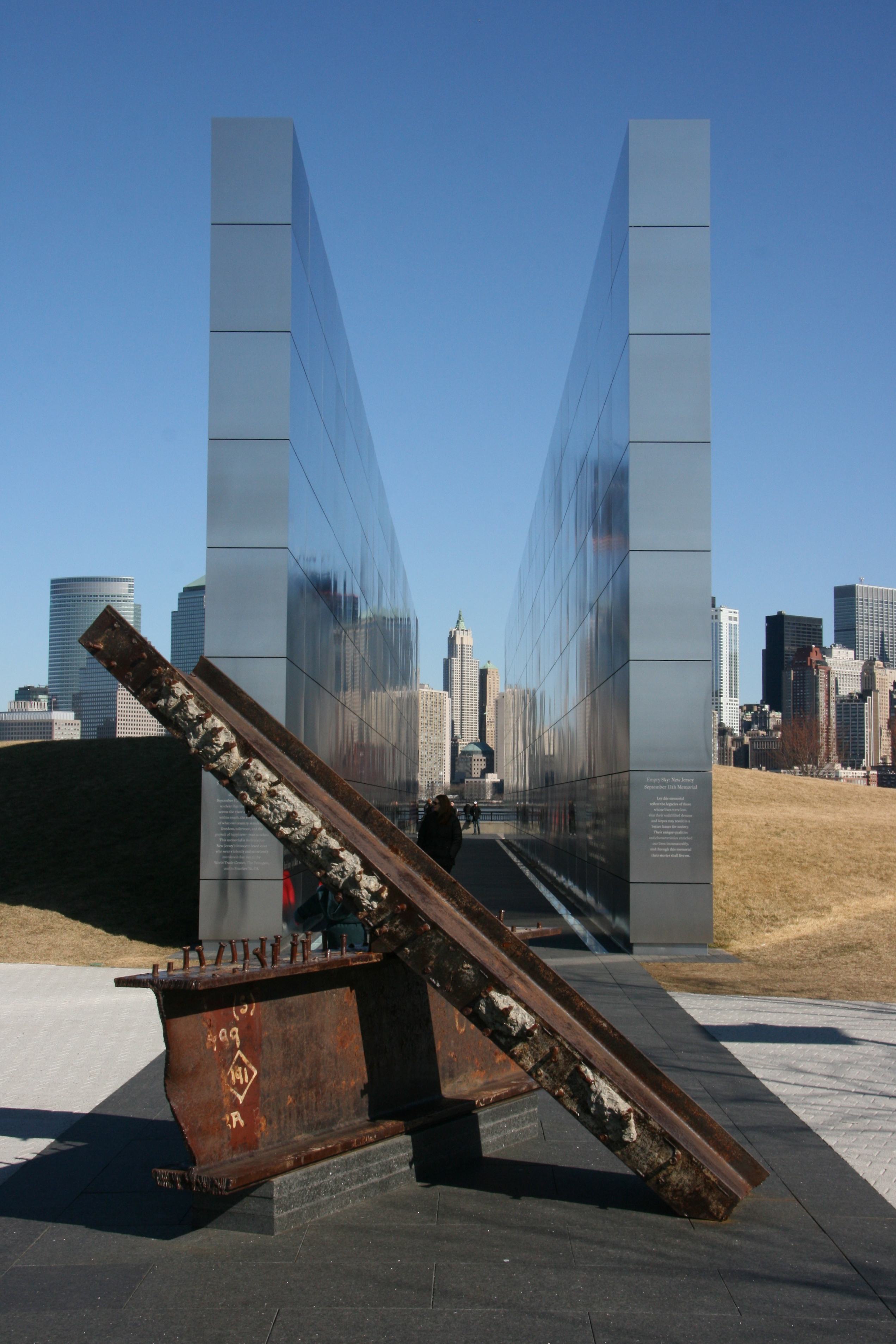
Last February, I paid the first visit of my life to the Statue of Liberty and Ellis Island. There’s a ferry to Liberty Island and Ellis Island that departs from Liberty Park, New Jersey, and at that site, next to a historic former rail station that served as a gateway to America for tens of thousands of immigrants, there now stands a stirring and fitting memorial to New Jersey’s victims of the 9/11 attacks titled “Empty Sky”.

I’m not usually a fan of the stark, industrial-modern style of memorial that has followed in the footsteps of Maya Lin’s Vietnam War Memorial, but I think what was done at Liberty Park works well.

Parallel walls, 30 feet high and as long as the Twin Towers were wide, carve out a channel that’s oriented toward the World Trade Center site. Entering the space between the walls evokes the awe-inspiring sensation of standing between the towering buildings. Meanwhile, your eye is drawn down the man-made channel toward Ground Zero, just across the Hudson — a view that tends to focus the mind.

You also find yourself in a private, contemplative space where the names of New Jersey’s 9/11 dead have been inscribed and can be read on the interior wall surfaces. I found it a fitting memorial overall — far from the cold and sterile monument one might expect from its physical description. Any possibility of that is canceled out by the pair of steel beams recovered from the World Trade Center wreckage, that sit starkly at the far end of the channel just outside the walls. If anything, the absence of human forms (one of the common characteristics of modern memorials that usually rubs me the wrong way) succeeds in evoking a sense of loss and absence — a seemingly fitting reminder of those who were taken from us that day. Also, bear in mind where this memorial sits. Anyone standing at this site on the morning of September 11th, 2001 would have had a clear view of the horror, as American Airlines Flights 11 and 175 were flown by fanatical Jihadists into the World Trade Center towers.

Empty Sky memorial and World Trade Center beams

Sighting down the channel delimited by the walls, one can see the rebuilding occurring at the World Trade Center site. One World Trade Center (formerly dubbed the “Freedom Tower”) is visible at the left edge, and 4 World Trade Center can be seen at the right.

sighting down the Empty Sky memorial, toward the World Trade Center site

Here’s what the memorial looks like from the side:

Empty Sky memorial from side

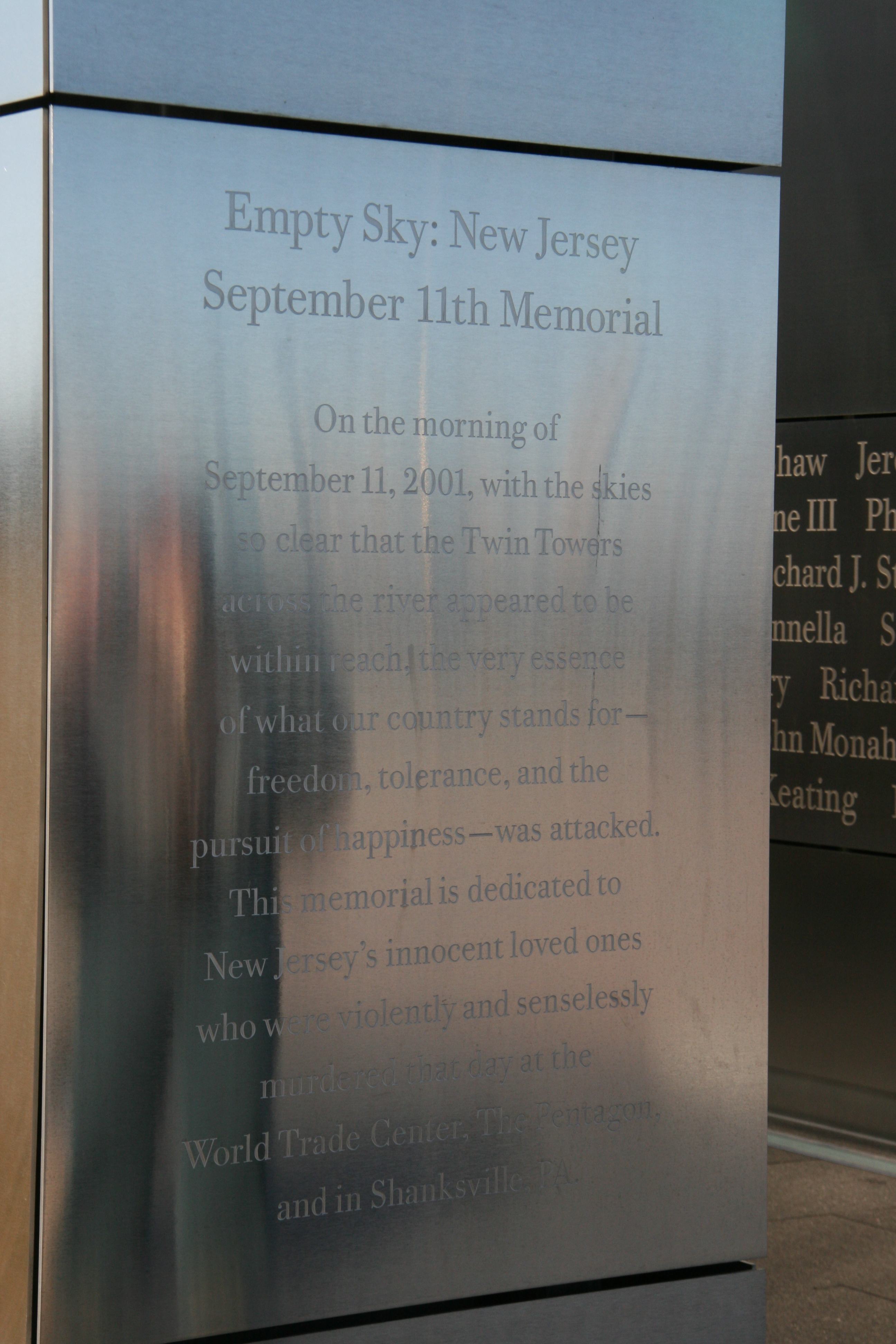
At each end, the walls are inscribed thusly:

Empty Sky memorial inscription 1

Empty Sky: New Jersey September 11th Memorial

On the morning of September 11, 2001, with the skies so clear the Twin Towers across the river appeared to be within reach, the very essence of what our country stands for — freedom, tolerance, and the pursuit of happiness — was attacked. This memorial is dedicated to New Jersey’s innocent loved ones who were violently and senselessly murdered that day at the World Trade Center, The Pentagon, and in Shanksville, PA.

Empty Sky memorial inscription 2

Let this memorial reflect the legacies of those whose lives were lost, that their unfulfilled dreams and hopes may result in a better future for society. Their unique qualities and characteristics enriched our lives immeasurably, and through this memorial their stories shall live on.

Note the fairly unflinching terms in which the attacks are described: those killed on that day were violently and senselessly murdered. Such moral clarity is too rarely seen, and welcome in my book. While it’s not clear to me how a memorial that immortalizes the victims’ names alone can succeed in helping their stories to live on, I give this design credit for getting a lot more right than wrong.

More pictures of the memorial can be found here.

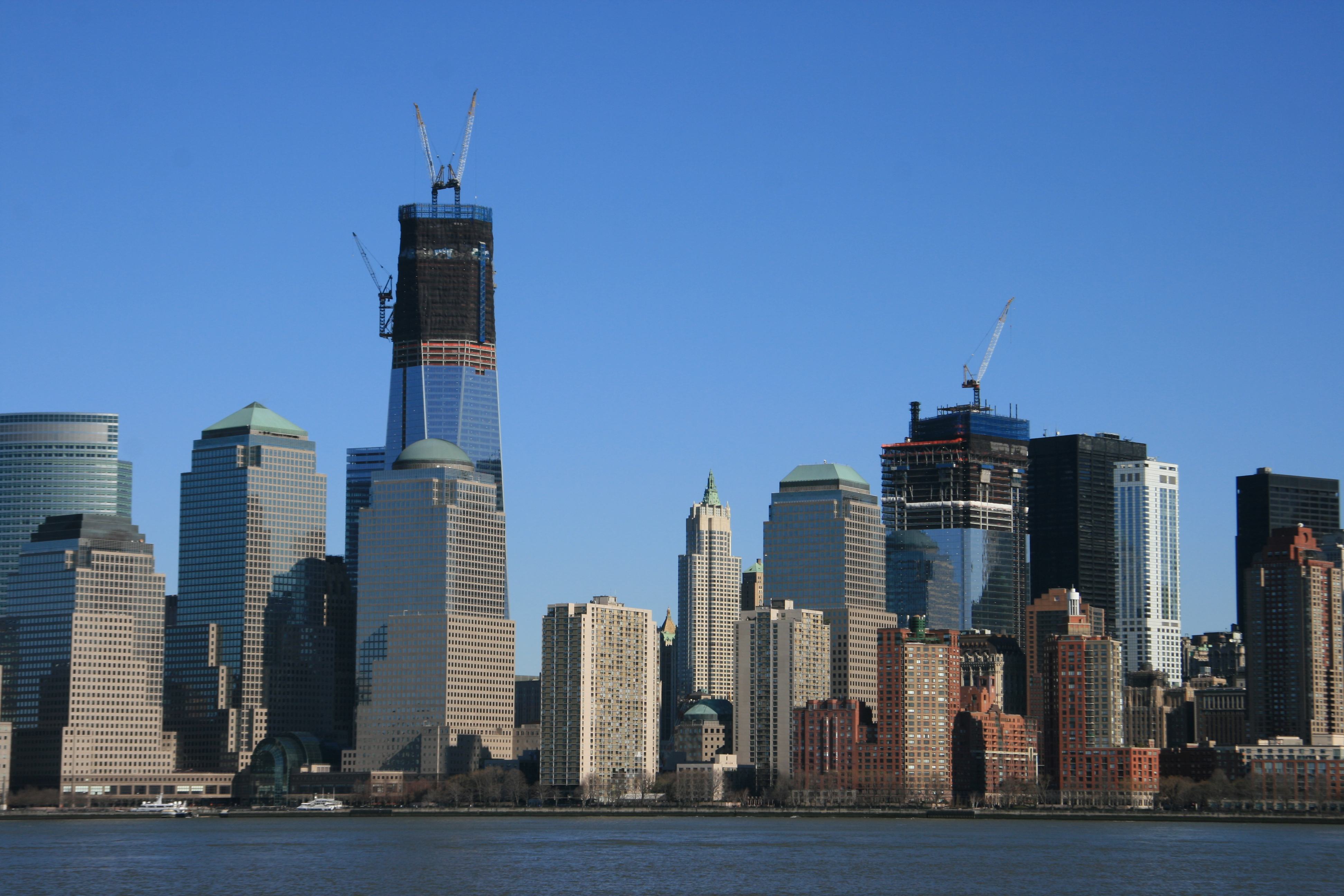
Here’s what Lower Manhattan looked like from that vantage point last February, by the way:

Lower Manhattan, from Liberty Park, New Jersey, February 20, 2012

Here’s what it looked like when I visited again ten days ago, on September 1st:

Lower Manhattan, from Liberty Park, New Jersey, September 1, 2012

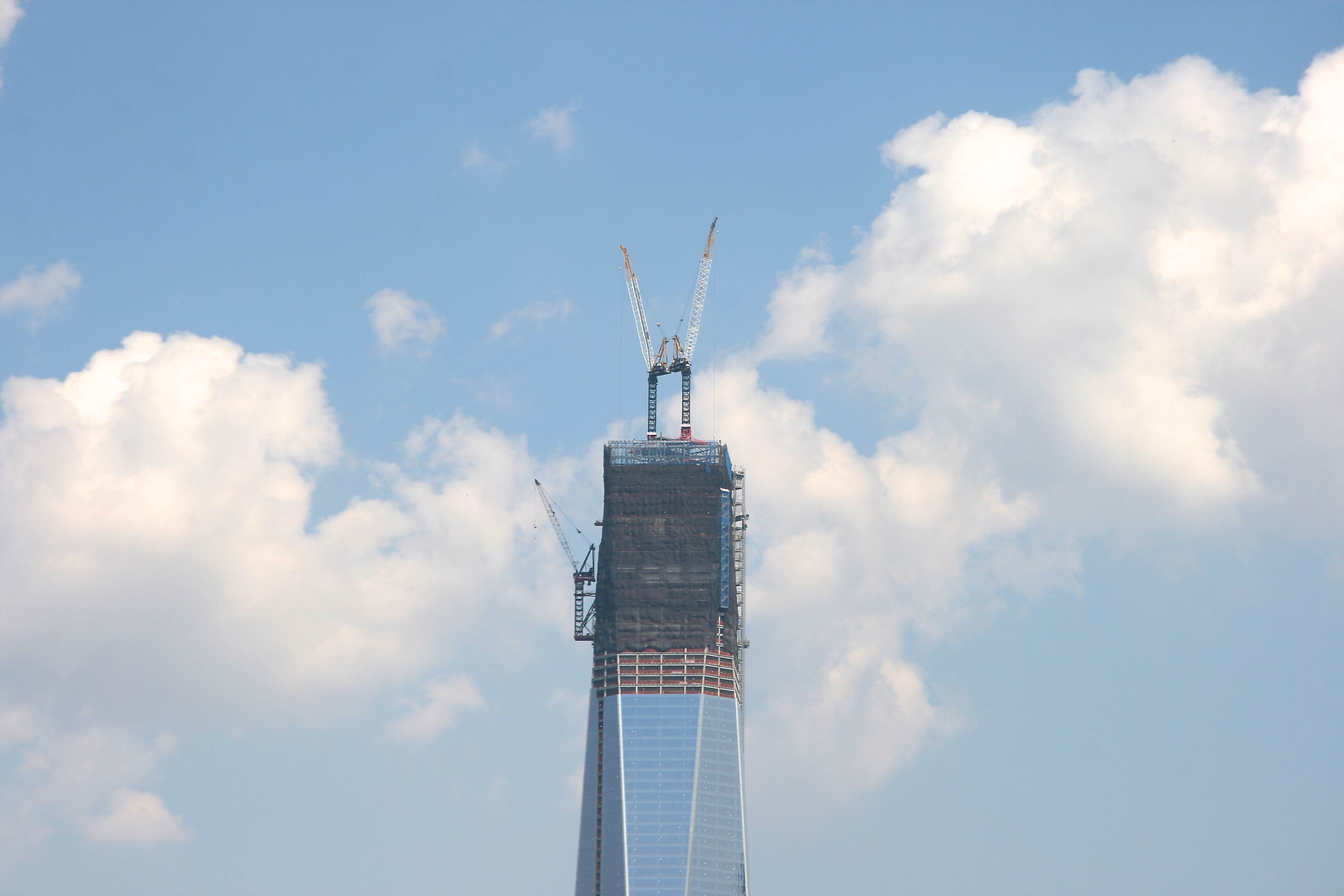
You can see clear progress on WTC 1 (left) and WTC 4, relative to the heights of the surrounding buildings. WTC 1 recently reached its symbolic final height of 1,776 feet. As I’ve written before though, it’s troubled me that it has taken us so long to rebuild at the WTC site, relative to what I know we’re capable of. The original World Trade Center towers opened 4 and 6 years after construction began. The Empire State Building, a smaller but still substantial high-rise project, was completed in a mere 410 days. During the Great Depression. We can still achieve such feats, if we choose to. Do we still have it in us?

top of WTC 1, September 1, 2012

Speaking of memorials: I have yet to visit the 9/11 memorial that is now open at the World Trade Center site. The need to obtain a ticket, and the advance planning that that requires, has only served to enable my hesitation about visiting. I visited Ground Zero two weeks after the 9/11 attacks, then again in November 2007 (and later posted some pictures from that day), but somehow the thought of visiting the completed memorial seems a different proposition. I just don’t know whether I can handle it without getting tremendously upset all over again. I’m not someone who needs convincing about the sorrow and grave implications of that day, and I don’t think I would find any solace there. But I know I’ll probably end up overcoming all that and visiting someday, and when I finally do, I’ll write about the experience here.

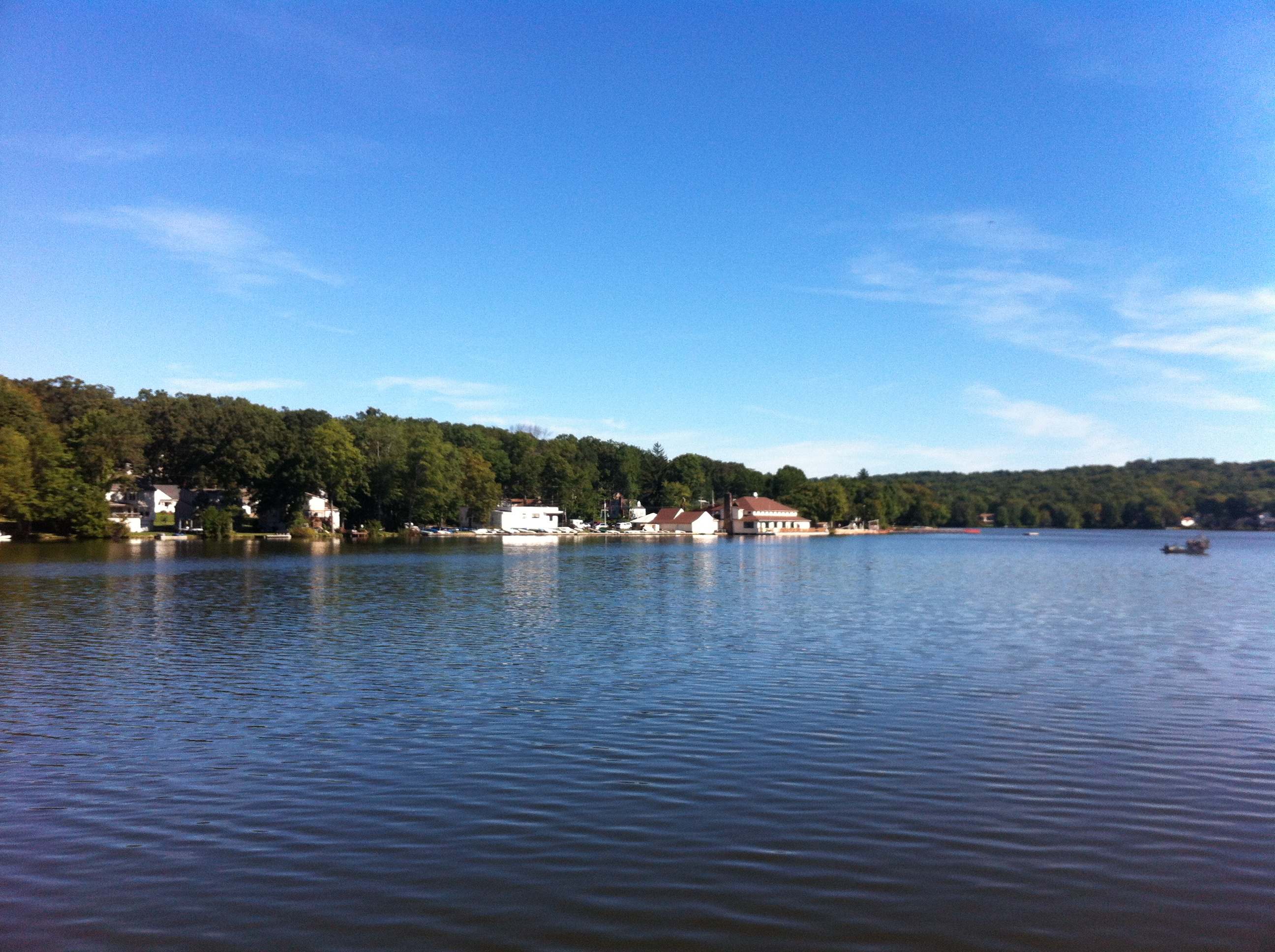
Here at the lake, it’s a crisp, clear day that can’t help but evoke one that began similarly eleven years ago.

Packanack Lake, September 11, 2012

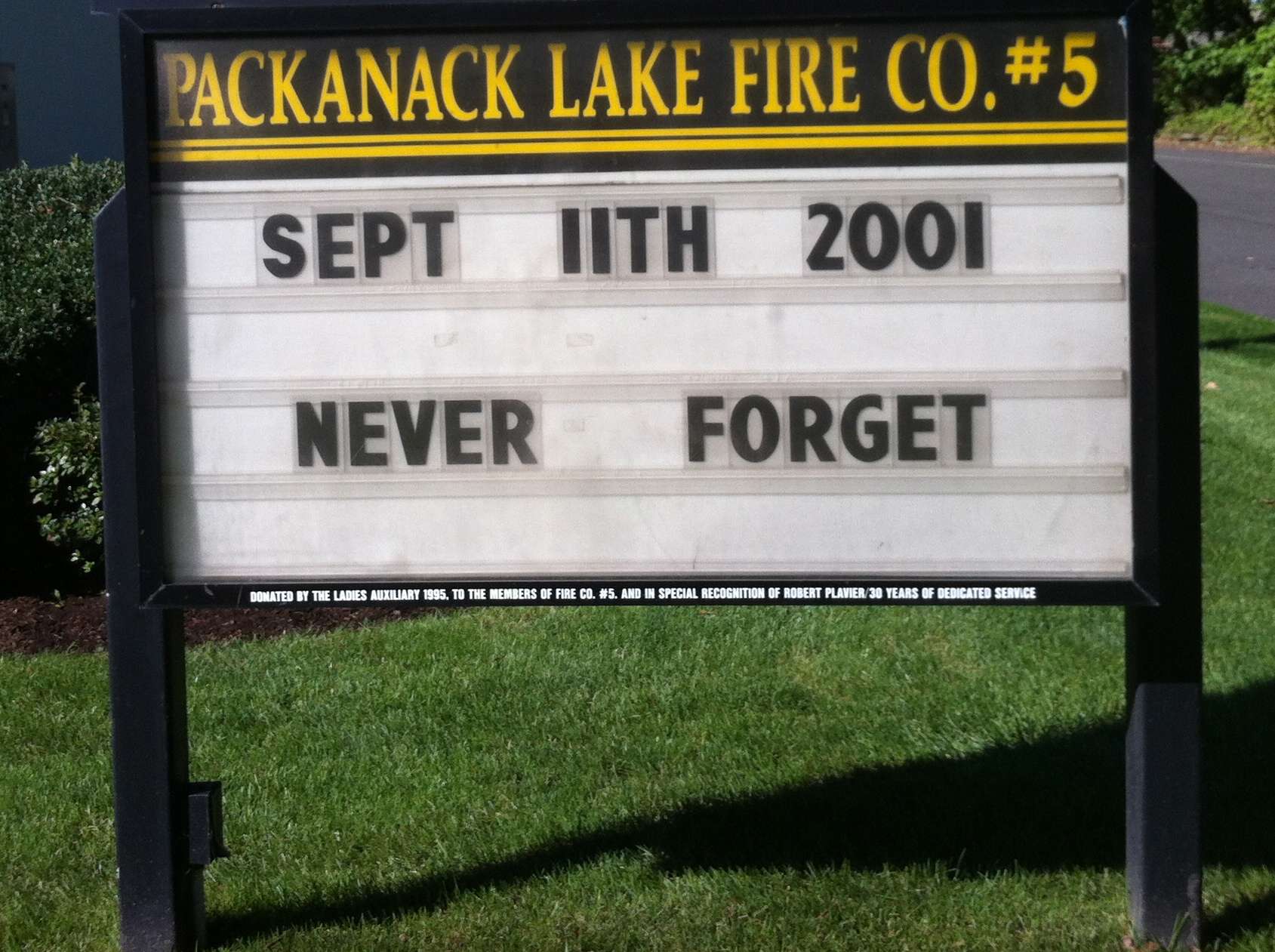
I went for a morning run, feeling grateful that, unlike so many whose lives and dreams and ambitions were cut short that day, I am still here and have the precious opportunity to continue to strive against my limits. Our local volunteer fire department has a commemorative message up. A fraternity of first responders forged in a shared willingness to run toward danger will not soon forget its fallen heroes. Nor should we.

sign at Packanack Lake Fire House, September 11, 2012

V.I. Day 2011

Tuesday, November 22, 2011

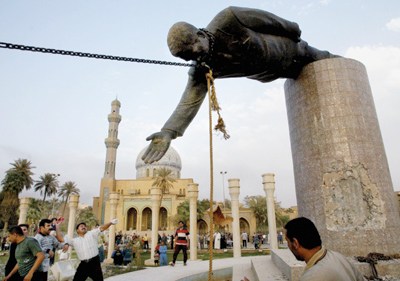
In 2008, blogger “Zombie” published a thoughtful, well-reasoned post discussing the conditions for victory in Iraq, and calling for November 22nd to be observed as “Victory in Iraq Day”. Continued progress and relative stability over the three years since seems to me to have vindicated that judgment, and in line with what I wrote on the occasion that year, I think we ought to carry on the tradition. The U.S. and her allies achieved what many vehemently declared was impossible, ousting one of the world’s worst dictators, liberating the Iraqi people, and planting the seeds of freedom and representative democracy in what has been one of the most politically troubled and volatile regions of the globe. Today’s Iraq has its challenges and problems, to be sure, but it is a place far more full of genuine hope than it had been under two decades of Saddam’s brutal dictatorship, and stands as a stark and unflattering counterexample to the remaining dictatorships that surround it, have acted to undermine it, and feel their grip on power threatened by its very existence. Those are all things to be grateful for and to celebrate.

Even President Obama, who as a senator vigorously opposed what he declared to be an ill-motivated, ill-conceived, and unwinnable Iraq war, and as a candidate opportunistically vilified the war and the Bush administration, promising an immediate withdrawal of our troops if elected, no matter the consequences, has had to quietly concede that the U.S. won the very war he campaigned against. Once in office, and I suspect apprised of facts and perspective that only presidents and their military advisors have access to, he scrapped his promises of immediate and unconditional retreat and defeat to embrace the same overall policies and drawdown plan of the Bush administration that he previously demonized.

The Bush administration didn’t take it upon itself to declare victory, and it was clear that neither candidate Obama nor the press were about to do any such thing. It was up to others to do so, and I’m grateful to Zombie and the participants in 2008’s V-I Day for leading the way.

Victory in Iraq Day banner

I’m not one to focus on the negative, but there is something I hope will not be forgotten about this war, that I fear history books will not amply record: the way that victory was achieved despite the most intense vilification of American conduct and motives that I have seen in my lifetime. The opposition brought their biggest rhetorical guns to bear, some among them stopping at nothing and accusing us of the most vile, malevolent intentions. We were charged by some with going to Iraq to steal their oil, to claim the land as a permanent colony of our vast, overbearing Empire, or simply for the implicit joy of killing dark-skinned people. There are people for whom it is a foregone conclusion that such actions are clearly and exactly what the United States is all about, for whom we are the exact polar opposite of all that we claim to stand for, because in order for those people to win hearts and minds it must be made to be so. The record of our actual conduct proved otherwise, casting our soldiers’ actions in start contrast with the brutality of foreign fighters who committed themselves to the failure of the Iraqi project at all costs, deliberately inflicting the kind of mass civilian casualties that the United States takes greater pains than any combatant in history to avoid. Sadly, history’s record will not prevent the same accusations from being endlessly recycled. We will fight identical smears again in future conflicts — I feel sure of it — and we had therefore best learn from this experience and be mentally prepared to battle the same calumnies again.

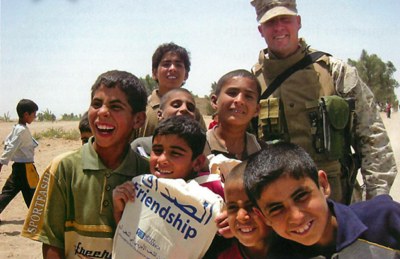
As I wrote on my recently added “Welcome” page, and meant it: I feel deeply, humbly grateful and indebted beyond capacity for adequate repayment to the men and women of the United States armed forces, and equally so to our truest friends in this world, the soldiers of our stalwart allied nations, who daily risk everything they have in this brief life for the liberty and safety of others, setting aside even their own. Let there be no doubt: I want them to have the full support that their risk and sacrifice merits, and I want them to be given every chance to succeed that they ask of us — precious little to expect, I think, in return. They have my sincerest admiration, and with remarkably few exceptions that serve to prove the rule, I am deeply, deeply proud of their demonstrated ethics, courage, fairness, generosity, resourcefulness, and professional conduct as our emissaries in hostile lands. The precious, fragile free society that we so often take for granted is the very thing they are risking all to preserve and defend, and they should have our heartfelt gratitude.

Marines passing out Spirit-of-America-provided school supplies in Ramadi, Iraq

To those who risked all to make Iraq’s liberation possible, and to those who lost all making it happen, may you forever have the gratitude of the freer world you left behind. You are the best of us, in my book, and we are lucky to count you as our fellow citizens.

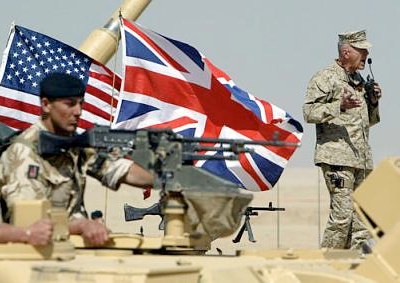
US and UK troops make preparations in Kuwait, 2003

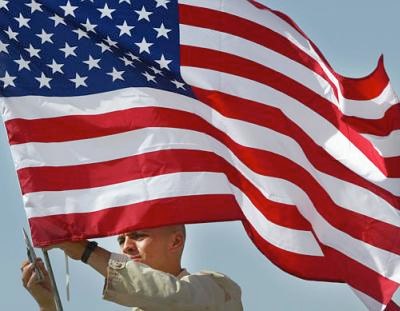
US marine flying colors, Kuwait, 2003

the famous toppling of a Saddam Hussein statue

For additional perspective, see Bill Whittle’s September 2011 “What We Did Right,” which, among its survey of the decade since the 9/11 al Qaeda attacks, examines the results of our intervention in Iraq.

Whittle: What We Did Right

Friday, September 16, 2011

“What We Did Right” in the decade since 9/11: Another great Afterburner, thanks to Bill Whittle’s aptitude for placing events in Big Picture perspective:

at PJTV and on YouTube

Dennis Prager: Lessons from 9/11? What Lessons?

Tuesday, September 13, 2011

At Prager’s site (via @inhuggermugger)

After 9/11, the normal and decent question that normal and decent people — people who fully and happily recognize the existence of vast numbers of normal and decent Muslims in the world — would have posed is this: What has happened in the Arab world and parts of the Muslim world?

But as this, the most obvious question that 9/11 prompted, has not been allowed to be asked, what lessons can possibly be learned?

The answer is, of course, none.

Ten Years Later: 9/11 Links

Sunday, September 11, 2011

I’ve posted my own 9/11 reflections here.

Following are links to some of the most stirring writing I’ve seen today. I’ll continue adding to this list as I go.

Never forget. Never submit.

This YouTube video should make every decent person sick: Counter-demonstrators forced to disperse, while Islamic Supremacists holding signs that call for “Jihad” and declaring “Islam Will Dominate the World” freely spew their rage and burn our flag outside the U.S. embassy in London on 9/11/2011:

James Delingpole commented on this at Ricochet, in: “Western Civilization to barbarians: ‘Please. Come right in. The gates are wide open…’

9/11 is now “National Grandparents Day”! No, really.

Dana Loesch: “My 9/11 Awakening”

Sundries Shack: “9/11, The New Tet”

Ezra Dulis: “9/11: The Hijackers Were Soldiers, The Speech Police Are Terrorists”

@bapartofmylife: “9/11 is a Day of Mourning”

Perfection Under a Red Umbrella: “10 Years Later, Ground Zero & The Pentagon, Hallowed Ground of Flight 93”

GayPatriot: “In Memoriam - James Joe Ferguson Lost Ten Years Ago Today”

All I could remember was how happy Joe always was and how that cheer was infectious to all of his friends and colleagues. I would miss that cheerful influence on me. Joe had made the choice to live life to the fullest extent possible. He was the model of the optimistic American who knows no frontiers and no bounds. He was doing more than his fair share of contributing to a better society.

Mark Steyn: From “Let’s Roll” to “Let’s Roll Over”

And so we commemorate an act of war as a “tragic event,” and we retreat to equivocation, cultural self-loathing, and utterly fraudulent misrepresentation about the events of the day.

Larry O’Connor: “9/11 Was Declaration of War”

Ed Ross: “The Legacy of 9/11 is about much more than terrorism”

Andrew Klavan: “When Hollywood Hit Rock Bottom”

John Nolte at Big Hollywood: “September 11th: My Thanks to Joel Surnow and His Fellow Hollywood Subversives”

James Lileks: The Lake and the Sky

A Plea, Ten Years After: Please, Open Your Eyes

Saturday, September 10, 2011

In past years, I’ve written about where I was on 9/11, posted quotes, written about songs, tweeted the names of victims, and recommended blog posts, articles, and videos. But on nearly every anniversary of the 9/11 al Qaeda attacks since I started blogging, the unifying issue on my mind has been nearly the same: To assess where we are and how we are faring some years after.

Reviewing what I’ve written in years past, I find that my answer to that question has changed very little, and the farther we get from that awful day the more that fact worries me, for despite having successfully thwarted at least 19 subsequent would-be attacks, I don’t think we’re faring very well as a culture, in crucial ways that for me raise serious questions about what our long-term future will hold.

I try not to let the gloom envelop me. In so many ways, I am an optimist in my heart of hearts. I have tremendous confidence in our culture and way of life, in our resilience and adaptability, and in all that we can achieve with our ingenuity and dedication and mutual goodwill. Yet it kills me to see that same culture mired in and hobbled by an unwarranted mentality of self-recrimination and self-doubt, and simultaneously unwilling to candidly examine and confront an ideological movement that is actively, deeply, vocally, immutably, and demonstratedly hostile to its foundational principles and continued existence.

What does it mean to live in a culture that is only just barely willing to stand up and fight for itself in the wake of a horrific act of war such as the 9/11 attacks? I would not have thought our present-day frame of mind possible to sustain after such an event, but the cultural and political divisions that predated 9/11 have proven far more resilient than I would ever have expected. We didn’t wake from our slumber of infighting to pursue, united and with doggedly committed determination, the defense and preservation our nation and way of life; rather, we retrenched and resumed fighting each other, our cultural fault lines painfully underscored in the process. As Michele Catalano wrote three years ago,

In so many ways, 9/11 ended up furthering any divisions we had instead of closing them. We chose up sides and backed away from each other as if we were our own enemies —- as if the enemies we had, those who steered planes into buildings, weren’t enough.

This realization, and the seeming impossibility of bridging the chasm, has been a knife in my heart ever since. It kills me. But I don’t see any way around it.

So many aspects of our cultural condition have caused me grief over the past ten years. I feel crestfallen that it is taking us as long as it has to rebuild at the World Trade Center site. I’ve felt deeply betrayed by a Hollywood that now routinely denigrates and vilifies the country whose values and achievements it once celebrated and defended, a Hollywood that I loved in my youth but have now all but written off and given up on. I have been deeply disappointed in a supposedly mainstream American press that seems to have seen it as its sworn duty to demoralize us and convince us of inevitable defeat and dishonor in the wars we’ve prosecuted, in a way that’s been shown to be transparently contingent on the political party of the President in the White House. I’m troubled that over the past three years, we’ve largely acted in ways that can only serve to embolden our enemies, while giving our friends and allies and those we should at least be lending moral support in their fight for freedom and against totalitarianism (c.f. Iran’s democracy activists, and other participants in the recent “Arab Spring” uprisings) scant reason to hope for the backing of a country that has for so long been thought of as a beacon of hope and the moral “leader of the free world”. It makes my heart sink that too many of our own citizens seem to believe that America is the problem in some form or other.

All of these cultural factors pain me and deeply trouble me, but on this 10th anniversary of the 9/11 attacks I’m willing to largely put them aside in the interest of getting just one, crucial point across regarding the single most dangerous problem we face: the inability or unwillingness to name, frankly discuss, and squarely face our ideological enemy. More than anything else, it is a commitment to reckoning with this circumstance that needs to cross the perhaps otherwise impassable ideological chasm that separates the American Right and Left.

We can and will continue to differ with our countrymen regarding specific policy prescriptions, including matters of war. I could perhaps accept that, in a world where I felt we had all made a candid and fully informed assessment of the adversary we are up against. But there are still many among us who don’t seem to want to look Islamic Supremacism in the face, or even acknowledge its existence, either because the prospect is too frightening, or because the acknowledgment would violate long-practiced “PC” rules of cultural conduct that are so deeply ingrained in us, we fear we wouldn’t know how to function without blindly deferring to them. If I could make one plea to my fellow countrymen, Left, Right, and Center, it would be this: Please, please look with open eyes at what we are up against. Even if you must conclude that Islamic Supremacism is a fringe ideology with no real possibility of gaining dominance or causing substantial long-term harm to the free world (I truly wish I could believe it was so), do so with a full understanding and awareness of what the Jihadists intend for us, far-fetched or not, as detailed in their own words and actions: the return of a 7th century Caliphate that is fundamentally incompatible with and hostile to secular and pluralistic free societies, with all the attendant implications for women, homosexuals, infidels and religious and ethnic minorities. These Jihadists have told us their intentions time and time again, but we somehow refuse to believe them.
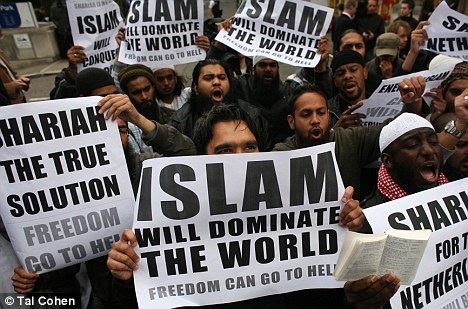
We are so conditioned to reflexively genuflect to any and every other culture as a show of goodwill, that both our critical thinking faculties, and our courage to overcome fear of social reprisals and voice our honest concerns, seem to have become disengaged or defunct. If every culture and religion in this world was as benign in its intentions toward us as most are, this willful blindness wouldn’t be a big problem. We could all live together in happy harmony and the “coexistence” that so many understandably wish for. But the fact that most others have relatively benign intentions has disarmed us to the crucial few that do not. Our cultural defenses are down — way down — and even being caught off our guard ten years ago with horrific consequences doesn’t seem to have changed that sufficiently. Informing and educating ourselves about what we’re up against is crucial, for we cannot expect to remain both ignorant and free.

Is this state of denial (or leaning strongly toward diplomatic use of language, if you prefer) causing any real problems? It certainly seems to be. How else could a man like Nidal Malik Hasan remain in active service in the United States Army, after repeatedly making statements against the United States and in sympathy with our Jihadist enemies? There are compelling and deeply troubling indications that not only our armed forces, but our broader defense and law enforcement agencies are compromised in their ability and sworn duty to protect this country and its citizens by pressure to whitewash reality, sanitize the use of language that could be perceived as hurtful or offensive, and shrink from confronting reality. We are letting organizations such as CAIR — a front for the Muslim Brotherhood, whose charter calls for a “grand jihad in eliminating and destroying the Western civilization from within and ‘sabotaging’ their miserable house by their hands and the hands of the believers so that it is eliminated and God’s religion is made victorious over all other religions” — advise our FBI on how to combat violent Islamic radicalism.

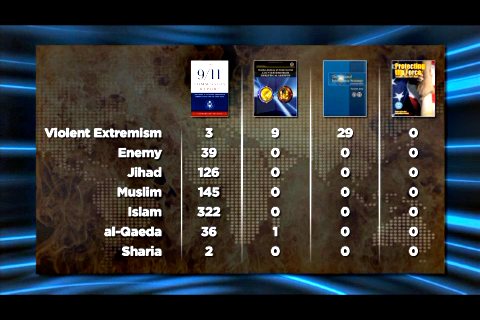
Bill Whittle’s April 7, 2010 PJTV piece “The Censorship Agenda” revealed in worrisome detail the sanitizing of our foundational national security documents that has taken place since the original, bipartisan 9/11 Commission Report. (As Bill himself suggests, contrary to the provocative subtitle “Obama Bans ‘Islam’”, the culture of self-censorship and willful blindness that produced these results may very well be indicative of a long-extant problem that predates the Obama administration.)

Think about the implications of Bill’s findings: in stark contrast with the comparatively frank and sober assessment of the 9/11 Commission Report (whose use of key terms is tabulated in the leftmost column, below), the FBI’s 2008 Counterterrorism Analytical Lexicon (next column), our 2009 National Intelligence Strategy report (next column), and the Protecting the Force: Lessons from Fort Hood report on the shooting rampage by Nidal Malik Hasan (rightmost column), use the terms “Islam”, “Muslim”, and “Jihad” a total of zero times.

Zero.

The National Intelligence Strategy report doesn’t even reference “al Qaeda” or use the word “enemy” (employing, instead, the term “violent extremist”, a total of 29 times). The DoD’s Fort Hood report, amazingly, makes no reference whatsoever to “violent extremism”, “Islam”, “Muslim”, “Jihad”, or even to Hasan’s name.

Think about this. Disregard, for the moment, our popular culture and variously informed conversation among Joes like you and me. How is it possible that the very institutions we charge with our defense — whose analyses one would expect, of necessity, to be unflinchingly sober and frank — have become this willfully blind?

I can only shake my head in near-despair at the self-sabotaging ridiculousness of it. It might be funny if the consequences weren’t so dire for all of us. (Bill, however, has a more upbeat outlook than I do this year.)

Forget about applying the non-lethal (but awfully emotionally insensitive) tool of humor by mocking our enemies, which appears to be completely out of the question save for a few valiant out-of-the-mainstream efforts such as Shire Network News and Sands of Passion. In most cases, we can’t even bring ourselves to precisely and candidly refer to them. If our thinking and definitions are clear, there should be no reason not to do so, given all that is at stake.

This man has the right idea (emphasis mine):

There is nothing insulting to decent, good members of the Muslim religion when I say “Islamic extremist terrorist”, any more than it is insulting to the Italian-American community (when I was a prosecutor) to say the word “Mafia”. Or that it would be insulting to decent Germans to say the word “Nazi”.

One mistake to avoid is political correctness. You can’t fight crime, and you can’t deter terrorism, if you are hobbled by political correctness. I believe that Major [Nidal] Hasan is an example of that. There is no way that Major Hasan should have been a major in the United States Army, after several years of spewing forth hatred for the United States of America… I would consider Major Hasan’s attack on Fort Hood an Islamic extremist terrorist attack. I have a hard time understanding why the government doesn’t see it that way, since he was yelling “Allahu Akbar” when he started killing people. …

… We cannot use this as an opportunity to say, “let’s put this behind us”, because if we we do that, we will repeat the mistake that we made before September 11th, which is not evaluating correctly the scope and the danger of Islamic extremist terrorism. Notice I use those words and I use them often. I do because I have a simple belief: If you can’t face your enemy, you can’t defeat your enemy. If you can’t honestly describe your enemy, there are distortions in your policy decisions as a result of that.

Re-read that last part, and internalize the essential lesson: If we refuse the accurate use of words, we are sabotaging ourselves.

Since accusations of “Islamophobia”, etc. are now flung automatically against any who express concern about Islam’s militant political arm as exemplified by the likes of al Qaeda and Hamas, let me be as clear as it’s possible to be, knowing full well that “it is impossible to speak in such a way that one cannot be misunderstood” (or willfully misinterpreted): I really don’t want to spend my time writing and thinking about this stuff. I have no intrinsic need to gratify myself or feel superior by grinding ideological axes against either an external enemy culture or my own countrymen. I’d much rather invest my time and energy inventing, innovating, creating, raising my son, spending time with my wife, living and working and striving to do better among peers whose origins span the globe, but who share a necessary basic dedication to the essential principles of a free society. I would love nothing more than to be decisively proven wrong about all of this, and get back to my life. I think and write about this kind of stuff because, as far as I can tell, there is no avoiding it. The very culture that furnishes and protects my ability and yours to live our lives as we do and freely engage in such humanity-advancing work, is under attack by another that demands our submission to a suffocating, stifling, totalitarian ideology. If we cannot name, discuss, and confront that ideology, we might as well surrender to it.

My “endgame” — the long-term future I hope for — is not a perpetual state of war (who would wish for that?), but a true coexistence of stable peace and security that can only exist after the Islamic Supremacist threat has been acknowledged and somehow neutralized. That is to say, I seek a peace worth having. To whatever extent we can accomplish that without resorting to the use of force and violence, wonderful — you have me on your side. I want and hope for a future where I can freely live, work, and prosper alongside all others who share my commitment to upholding the essential principles of our free society, Muslim and non-Muslim alike, regardless of where on the globe they hail from, without any of us having to fear violence from totalitarian nutjobs. There is too much to do and achieve for us to waste our time, capabilities, and resources on war where we have a reasonable alternative. But to shrink from the last-resort necessity of war when it is upon us seems to me no less a betrayal of the society we rightly cherish, for if left undefended that society will crumble.

I speak “peace”, when peace is spoken.

Even when we are not in our worst moments of genuflecting self-censorship, our choice of terminology has been clumsy, muddled, and unhelpful from the start — and, make no mistake, these poor choices of terminology sink us. Case in point: A “War on Terror” is no more meaningful than a “War on Blitzkrieg”, or a “War on Kamikaze strikes. Terror is a tactic, not an identification of the ideology that motivates its perpetrators. The ideology we’re up against is is most accurately described as “Islamic Supremacism” — a militant, political branch of Islam that sees as its imperative the subjugation under strict Islamic law (Sharia) of all non-Muslims and any who wish to live in free and pluralistic societies. To attempt to broaden our response to al Qaeda’s brand of violent Islamic Supremacism into a “War on Terror” is to dilute our sense of purpose, and pretend against evidence that there are just as many terrorists motivated by various other ideologies who pose an imminent threat. This awkwardly vague and clumsy choice of words was, I think, both an attempt to avoid any reference to or indictment of any sect of “Islam”, and a well-intentioned overture of comradeship to other nations who had suffered terrorist scourges of other origins, but in the end I believe it’s been an ill-advised one. Since we’re not supposed to draw any connection between acts of terrorism and even a small, extreme, ostensibly non-representative minority fringe of Islam, we try to make do with the unhelpfully vague “War on Terror”, and it’s a wonder if we don’t forget what, in fact, we are fighting against.

I’m out of words, but I hope I’ve made my point clearly.

Please, my friends. Before you decide this is not your fight, read, research, learn. Our shared future is at stake.


Recommended Watching

I’ve watched this memorial slideshow every year. It unfailingly moves me to tears. Never forget that day, nor misremember. Never forget those we lost, the heroes who ran unbidden toward danger and lost their lives saving others, the heroes aboard Flight 93 who lost theirs preventing another attack that would likely have killed scores more of their fellow citizens…

Inside 9/11: an in-depth accounting of the 9/11 attacks and the events that led up to them

102 Minutes that Changed America: a uniquely composed account of the attack on New York, seen through raw footage from a variety of sources, combined with emergency calls and radio communications

Recommended Reading

Of all the deeply moving posts, pages, and articles I’ve seen about 9/11, this one from 2009, comprised of stirring photos and an unflinching examination of the enemy and cultural crisis we face, is unforgettable and not to be missed: 9/11: Never Forget, Never Give In

I’ll also be posting links, separately over the next few days, to the best writing about 9/11 I encounter this year. Look for posts tagged “9/11”.

My Previous Years’ Posts

2009: Tomorrow is 9/11 ~ My Experience of September 11, 2001 ~ 9/11 Quotes

2008: 9/11, Seven Years On ~ 9/11, Seven Years On, Part 2 ~ 102 Minutes that Changed America

2007: 9/11, Six Years On

2006: Soon, Time Again to Reflect ~ 9/11 Observances ~ 9/11 Observances, Part 2

2005: I Remember

2004: Remembering and Rebuilding (Yes, that’s me, in a post at my old blog. I’ll be transitioning to blogging openly under my own name here shortly. It’s about time.)

At Long Last!

Monday, May 2, 2011

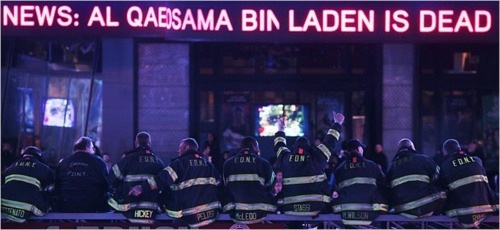
New York Firefighters, Times Square, May 1st, 2011

Poliwood: Cultural Suicide Watch: Will Hollywood Embrace Islam?

Saturday, October 23, 2010

I always enjoy Lionel Chetwynd & Roger Simon’s exchanges regarding moviemaking and Hollywood’s political culture. This episode is especially important:

Poliwood: Cultural Suicide Watch

Index of Bill Whittle's "Silent America" Essays

Wednesday, March 24, 2010

UPDATE 2012-05-25:Fantastic news! “Eject! Eject! Eject!” is back on the air — and, with it, every single one of Bill’s superb “Silent America” essays, including the long-lost (except in print form) History, Victory, Magic, Responsibility, Strength (including Part 2), Deterrence (complete with its Part 2), Sanctuary (yes indeed, dear readers, there’s a Part 2 too!), and Power!

Here’s an updated list. Please disregard the list further below that I’ve crossed out.

(ps - Try setting your browser to ISO Latin 1 encoding If, like me, you see ‘?’ placeholder characters where much of the punctuation should be when viewing some of Bill’s essays. For Safari, this is “View” -> “Text Encoding” -> “Western (ISO Latin 1)”. Bill’s site is mis-declaring the content as UTF-8. Oh well. You can’t have everything.)

From previous incarnations of this post:

Bill Whittle’s incisive “Afterburner” PJTV editorials have brought his sharp thinking to a whole new audience, but it was Bill’s brilliant and uplifting writing on the history, character, and spirit of America that I and many others first encountered. Bill’s superb essays — which he published first online at ejectejecteject.com, and later in print under the title “Silent America” — lifted me up when I needed it most, and are far and away some of the very best writing about this precious American civilization of ours that I have had the good fortune of encountering.

Since I often find myself recommending Bill’s “Silent America” essays, and since attempts to do so are bedeviled by the fact that many did not survive Bill’s move from ejectejecteject.com to pajamasmedia.com/ejectejecteject intact, I’ve compiled a list of them, with links to the ones that made it over. Thankfully, Bill has begun republishing them one by one at his new Pajamas Media address, and I’ve linked to the newly published copies where available. The “Silent America” essays are, in order:

Unfortunately “(broken)” means there’s almost nothing there to read. Most of these essays are truncated after the first few sentences or words. I’ll come back and update these links as each essay is, hopefully, republished. Meanwhile, the previous, “(broken)” links are just for reference.

There is, however, hope! You can buy the complete set of essays in book form on Amazon, which I can almost guarantee you’ll want to do after sampling Bill’s unparalleled wares.

Bill, by the way, can be found on Twitter as @BillWhittle.

Also, here’s a link to all the blog posts where I’ve quoted or mentioned Bill’s writing.

Enjoy!

Previous updates to this post:

UPDATE 2010-09-06: I’m delighted to report that one of Bill’s very finest essays, “Trinity”, is now back online. Don’t miss it. Thanks to reader David B. for sending the updated links!

UPDATE 2010-09-09: Freedom is back up too! (Thanks again to David B.!)

UPDATE 2011-04-30: Sadly, pajampajamasmedia.com/ejectejecteject started returning blank pages recently. I have an email inquiry out to the site admins about whether the Eject! Eject! Eject! archives can be brought back. Meanwhile, all of the following links are currently non-functional. I’ll try to keep on top of the situation and update this post when it hopefully improves. Thanks for visiting!

UPDATE 2011-08-13: I just noticed pajampajamasmedia.com/ejectejecteject is back online, and the above Silent America essay links appear to be working again!

Robert Spencer at His Best, on David Horowitz TV

Tuesday, December 9, 2008

More first-rate stuff on the “David Horowitz TV” video podcast: Robert Spencer, thoughtful expositor of radical Islamist ideology and chief poster at Jihad Watch, gives an excellent talk on the machinations of “stealth Jihad”. Don’t miss Spencer’s additional insightful remarks in the Q&A video that follows.

View the talk here, or subscribe to the podcast via iTunes to get this and other episodes in the series.

Especially if you haven’t had the opportunity to see Robert Spencer in action before, this is an excellent introduction to his style, his perspective, and what he does.

Terror Attacks in Mumbai

Thursday, November 27, 2008

A horrific night/day in India’s financial capital, and it’s apparently still ongoing. Most reports thus far estimate between 100 and 125 killed, and approximately 300 wounded, after gunmen opened fire and lobbed grenades at six or seven sites around the city. Responsibility for the attacks has yet to be clearly established, though some say this attack on soft targets has the hallmarks of an al Qaeda operation. Reports claim that in addition to the 14 police officers and 80 Indian nationals killed, the gunmen were questioning people and targeting holders of British and American passports. Hostages were taken; some released or escaped, some may still be held. The Taj Mahal Palace Hotel is ablaze and under seige.

A selection of current reports via Drudge:

BBC: Indian PM vows action on attacks

Breitbart: 14TH LD: 125 dead, more than 300 wounded in Mumbai terror attacks

Times Online: Foreigners targeted in co-ordinated Bombay attacks

Sky News: Mumbai Hotel Terror Attacks: Scores Killed In Violence Against Foreigners By Islamist Militants

Via Instapundit: a roundup at Barcepundit, and comments from Ann Althouse.

Lots of good stuff to catch up on

Saturday, November 15, 2008

I have more writing in mind that I hope to get to, including posting some brief post-election thoughts that I’ve been mulling over. Meanwhile, I’ve been occupied by the flood of particularly worthy and interesting writing by others that the election seems to have prompted. Following are some highlights that I’ve bookmarked with the intention of pointing them out, including some sober and probably sorely needed self-assessment from libertarian/conservative thinkers:

WSJ: Same Old Berlin Wall

One benefit of a Democratic Presidency is that it will expose the myth that U.S. disagreements with our nations are all the fault of the Bush Administration. Take the failure of NATO, and especially Germany, to supply more troops for the war in Afghanistan.

…

The Continent’s free-riding on U.S. security while criticizing the way that security is provided predates the Bush Administration and will outlive it. President Bush has mainly provided Europeans with an excuse for refusing the kind of cooperation they’d rather not provide anyway. Mr. Obama has promised a multilateral surge of troops into the Afghanistan-Pakistan front. He may find, like Mr. Bush, that most of those troops will have to be American.

James Lileks reminisces in “SuddenlyEnlightenedLand”:

Hey, remember after 2004, when the interior of the country was viewed with deep suspicion for its insufficient interest in a John Kerry presidency? Crude maps called it JESUSLAND, a place opposed to liberty and education. Well, shuck my corn and call me Orville: the red part of the country has been reduced to something that looks like a mild case of contact dermatitis.

The solid block of flyover Christiansts who spend every Sunday hopping up and down so they can get a head start on the Rapture appears to have turned into enlightened change-agent lightwalkers, and in a mere four years. Or, the people in the middle of the country weren’t all weirdoes who still harbored a grudge against the Renaissance, and viewed the coasts as they were greedy remoras fastened on the Real America. In any case, no one will make mocking maps of them now.

I remember well the mocking of “Jesusland” that immediately followed the 2004 election, from the supposed standard-bearers of “tolerance” and “diversity”. It was one of the experiences that helped clarify for me that only certain kinds of diversity are to be embraced and celebrated in the contemporary multicultural order, and that certain utterances get an exception from the usual concerns about “hate speech”. I felt deeply ashamed of fellow Californians who I saw engaging in this disparagement of their countrymen, this tarring with a broad brush of stereotypes that would surely be condemned if applied to any other culture or group of people. The sight of a “Can we secede yet?” sign enthusiastically brandished at a San Francisco protest that broke out after the election filled me with gloom and despair. I heard people on the left threaten both before and after the election that they would leave the United States — move to Canada, Europe, or some other such haven of decency — if Bush were to win (or “steal”?) a second term. I heard the same threat repeated again before this year’s election, both from celebrities such as Susan Sarandon and from others around me. Katie Granju had a good response to that kind of talk, I think:

[I]f your civic investment in American democracy is so weak that it hinges on one single candidate or issue or election, then you probably would be happier elsewhere anyway…

As for the outcome of those threats/promises back in 2004, I feel entitled to complain that of all those who vehemently insisted that they were leaving the country, not one of them has sent me a postcard. Because they’re all still here!

Lileks continues:

The lesson, as always, is that things change. Things will change again. And I expect that the GOP leadership will conclude that since things do change, they can sit back and wait for it to happen again. Which is a recipe for ensuring that the next such map has a thin red line like the one you used to use to open a Band-Aid.

There does seem to be a risk of taking political pendulum swings for granted. Pendulums can get stuck, you know.

More from Lileks in “Monday delights” (see the original post for the accompanying graphic):

Conservatives cannot help but be saddened and left out – the only possible event that could lift their spirits right now would be a headline that said REAGAN, BACK FROM THE DEAD, EATS BIN LADEN AND CRAPS TAX CUT, but pictures like this reminds the right that no one was ever this happy about Bush, even when the love was at its zenith. No one put him with George, Abe and Frank before he took office. Really, he was just The Next Guy, a caretaker in a post-history world. People forget how much “compassionate conservativism” stuck in the craw back then; the party’s own standard-bearer modified the terms in a way that managed to insult, mischaracterize, apologize, and reshape the debate all at once. It would be like a Democrat running on a program of “Logical Liberalism,” and not knowing why his own followers found the catch-phrase unhelpful.

Anyway. There are rumors of new Executive Decrees, which include magic Federal dollars for stem-cell research that uses human embryos - if you have any objections, you hate science - and a ban on domestic drilling and nat-gas exploration in public lands in Utah. (If you have any objections, you hate the environment.) The two form a nice mirror image: the former was a ban put in place to preserve a particular definition of human life; the latter is a ban lifted to preserve the environment. Again, it’s understandable: we only have one Utah, but we can always make more people. As long as they don’t live in Utah.

Will executive unilateralism remain a bad thing, a threat to our rights, or suddenly gain favor with old critics? Hmmmm. Cue the Jeopardy! theme. That’s a stumper

Mark Steyn: The Death of the American Idea?

While few electorates consciously choose to leap left, a couple more steps every election and eventually societies reach a tipping point. In much of the west, it’s government health care. It changes the relationship between state and citizen into something closer to pusher and junkie. Henceforth, elections are fought over which party is proposing the shiniest government bauble: If you think President-elect Obama’s promise of federally subsidized day care was a relatively peripheral part of his platform, in Canada in the election before last it was the dominant issue. Yet America may be approaching its tipping point even more directly. In political terms, the message of the gazillion-dollar bipartisan bailout was a simple one: “Individual responsibility” and “self-reliance” are for chumps. If Goldman Sachs and AIG and Bear Stearns are getting government checks to “stay in their homes” (and boardrooms, and luxury corporate retreats), why shouldn’t Peggy Joseph?

He’s got a point.

Along that line, a particularly sobering assessment from the inimitable P.J. O’Rourke: “We Blew It”. As I’ve said before, I generally part company with O’Rourke on issues of war (roughly speaking, he’s more of a “Big ‘L’ Libertarian”) but he does make good points on a number of other topics.

Tim Ferguson:

[M]aybe this is again the early 1930s, ushering in 20, 30, 40 years of soft socialism and cynicism about markets, a bent for the bosom of the organized state over the seemingly fractious pursuits of individuals. It did happen before in America. If hard times instead freeze opinions in place, then we may be looking to a long haul.

Short term or long term, what is to be done by those still enamored of an America “conceived in liberty”?

(Hat tip: Instapundit)

On a related note, Fred Smith wrote before the election, on Oct. 15th:

A world where economic interests are disenfranchised - indeed, even de-legitimized - is a world that will have little regard for economic - and, thus, indivdiual - liberty.

Accompanying all of this, fresh threats from a seemingly forgotten enemy: Via ABC News: Osama Bin Laden promising an attack that “Will ‘outdo by far’ the attacks of September 11” and will “change the face of world politics and economics”.

Nov. 10, 2008 al Qaeda threats

A promise that al Qaeda, in its present state, is capable of carrying out? — or just bluster? Let’s hope we won’t have to find the hard way.

Ayaan Hirsi Ali: Don't hand the jihadis a victory

Friday, November 7, 2008

Via Jihad Watch:

The heroic Ayaan Hirsi Ali discusses Obama’s campaign pledge to withdraw from Iraq in 16 months. From “Change, but not for better,” by Christopher Pearson in The Australian, November 8 (thanks to James):

Ayaan Hirsi Ali, one of radical Islam’s astutest observers, was her persuasive best on the subject last week. “The original impetus of Obama’s campaign was his pledge to withdraw from Iraq in 16 months. There is little doubt that if Obama were to implement this pledge, jihadis in Iraq and across the world, who see history in the millennial terms of a long fight against the crusaders, would feel victorious … The message such a precipitous withdrawal would send to the jihadis is the same message Spanish Prime Minister Jose Luis Rodriguez Zapatero sent when he rapidly withdrew forces from the coalition in Iraq after the Spanish election in March 2004: if you hang on long enough, you can scare the West away.”

Robert Spencer: "Ignorant and Free?"

Tuesday, November 4, 2008

At Jihad Watch:

“If a nation expects to be ignorant and free…it expects what never was and never will be.” — Thomas Jefferson

The level of ignorance about the nature and magnitude of the jihad threat is today higher than it has been since before 9/11. Indeed, we may consider that now that the nation has opted for the comforts of this ignorance, an era has ended tonight, one that lasted from September 11, 2001 until today. One approach to meeting the jihad threat — a deeply flawed approach, as we outlined many times here — will be set aside for another approach, one that is in some ways identical to the discarded approach and in other ways vastly different from it.

Will it work more effectively to stave off the advancing jihad? Time will tell. But I am not confident that another policy conceived in ignorance of the motives and goals of our enemies can possibly be effective in the long run to keep us free.

"The Third Jihad" Will Make Cultural Islamists Squirm

Monday, October 20, 2008

Patrick Poole at PJM on director Wayne Kopping’s new documentary “The Third Jihad”. I haven’t seen it yet, but intend to:

[T]he film is narrated by Dr. Zuhdi Jasser, a devout American-born Muslim physician, a former U.S. Navy lieutenant commander, and president of the American Islamic Forum for Democracy. Jasser has been one of the most outspoken American Muslim leaders against the agenda of radical Islam in the U.S. and the organizations that actively work to advance the jihadist cause against our country.

Let’s hear from more brave Muslim voices of this sort, please.

In The Third Jihad, Jasser pointedly attacks the central elements to the public narrative advanced by radical Islamic groups — that there is no problem within Islam, that there is no religious element to Islamic terrorism, and that any expressions of fear about the spread of Islamic extremism and terrorism are merely reflections of latent bigotry and Islamophobia of those concerned.

…

In the past two years, more material has been made public about the origins of CAIR and its network of allied Islamic organizations than ever before. And these strategic documents calling for a “civilization-jihadist process” dedicated to “a kind of grand jihad in eliminating and destroying the Western civilization from within” have been recovered through court-approved warrants and made public by federal law enforcement authorities. These documents have been submitted by federal prosecutors and entered into evidence in ongoing terrorism finance trials.

By all means read the whole thing, and don’t miss the clincher:

As Jasser observes, the chief obstacle to those advocating this global Islamic state through jihad is America itself.

Cowboys and Secret Agents

Saturday, October 4, 2008

Another fine article by Bill Whittle at NRO. Comment thread at Bill’s site.

Bill’s back on PJTV too!

Bruce Bawer: Who's Sleeping More Deeply?

Tuesday, September 30, 2008

An excellent article by Bruce Bawer, author of “While Europe Slept”, over at PJM:

In the current presidential campaign, only a small portion of the electorate seems to think that the war with jihadist Islam is a major issue. The one candidate who understood best what we’re up against, and who took it most seriously, Rudy Giuliani, was ridiculed across the political spectrum for being obsessed with 9/11 — as if the events of that day had been some kind of fluke or accident that has virtually no meaning for us today.

In depressing numbers, in short, Americans seem not to grasp the lessons of 9/11 — which should hardly be a surprise, considering how many journalists and politicians keep repeating that the terrorists are betraying a great and peaceful religion, that jihad means doing good works, and so on.

Well worth reading in its entirety, as are these earlier pieces by Bawer: An Anatomy of Surrender, and Why We Need More Leaders Like Vaclav Havel

102 Minutes that Changed America

Sunday, September 14, 2008

The History Channel has assembled a truly excellent “History Specials” episode regarding the World Trade Center portion of the 9/11 al Qaeda attacks. What’s remarkable about this documentary is that it’s the stringing together of raw footage from a variety of sources — mostly amateur, some professional — with no narration added, save for the backdrop offered by audio clips of emergency calls, NYFD radio communications, and the like. The sequence of events as seen and experienced by observers in various parts of New York City are left to speak for themselves.

“102 Minutes that Changed America” is available on iTunes here. It’s well worth watching if you can possibly stomach it. As I’ve said before, I think it’s vital that we remember and understand what happened on that day.

The episode description:

A new historical record is emerging of the sights and sounds of the attack on the World Trade Center. This two-hour special will distinguish itself from other 9/11 documentaries by using only unique and rarely seen and heard archive to document the 102 minutes between the first attack on the World Trade Center and the collapse of the second tower. This will be a lasting document whose unique material comes from a range of non-traditional sources, including amateur photography, video, and film; FDNY, NYPD, Port Authority and emergency dispatch radio recordings, photography and video; recorded voicemails; audio/video diaries; footage and stills broadcast or published outside the United States; electronic messages; surveillance camera footage; and “outtakes” culled from raw network footage.

9/11, Seven Years On, Part 2

Friday, September 12, 2008

I’m going to hold off a bit longer on posting my own 9/11 recollections, as otherwise promised yesterday. I’m not quite satisfied with what I’ve got yet, and it’s important to me to get this right.

Meanwhile, some highlights of the best stuff I encountered during this year’s trip through the news sites and blogosphere:

Via PowerLine, Debra Burlingame, sister of the pilot of American Flight 77 that was crashed into the Pentagon on 9/11, warns us not to “misremember”

There is a disturbing phenomenon creeping into the public debate about all things 9/11. Increasingly, Sept. 11 is compared to hurricanes, bridge collapses and other mechanical disasters or criminal acts that result in loss of life, with “body count” being the primary factor that keeps it in the top spot of “worst in the nation’s history.”

Misremembering is as dangerous as forgetting. If we must know one thing, it is that the Sept. 11 attacks were neither a natural disaster, nor the unfortunate result of human error. 9/11 wasn’t the catastrophic equivalent of a 3,000-car pileup.

The attacks were not a random act of violence or insanity. They were a deliberate and brutal act of war committed by religious fanatics engaged in Islamic jihad against the United States, all non-Muslim people and any Muslim who wishes to live in a secular society. Worse, the people who perpetrated the attacks have explicitly told us that they are not done.

Read the whole thing.

Robert Spencer at Jihad Watch:

[T]here has still never been a full and comprehensive discussion of the jihad threat in the American public square.

So seven years after the Towers went down and the Pentagon was wounded, the jihadists have every reason to smell victory — not in Iraq, where they are indeed on the run, but in their efforts to cow and intimidate the West into giving up all resistance to Islamization. It’s happening, but no one notices or cares, because it is happening in small steps.

More here: “Islamic terrorism is a myth”

Gateway Pundit asks: Why the relative silence from al-Qaeda on this seventh anniversary of 9/11?

New York-based Pamela Geller at Atlas Shrugs has pictures of this year’s 9/11 observances (and no small amount of accompanying lunacy) at Ground Zero.

(Update 9/14: Pam has video from her Ground Zero visit too: 911 “Truthers”, Bagpipes, and Great Americans)

Lahawk has a roundup of Ground Zero rebuilding news.

Neo-neocon re-posted an apropos piece from 2006, that touches, among other matters, on the foresight we wish we’d had in anticipating and guarding against the attacks:

But the clearest foreshadowing of the event that would henceforth be known only by those numbers, “9/11″—as though words were somehow inadequate to describe it—was its most direct predecessor, the 1993 World Trade Center bombing. That earlier attack distinguished itself in audaciousness by being the only large-scale Islamist totalitarian terrorist attack within the boundaries of the United States prior to 9/11.

And it was every bit as serious in intent. The only reason it wasn’t taken as seriously as it should have been was the seemingly Keystone Cops-like incompetence of its perpetrators. They would learn from their errors, and quickly. It would take us longer to learn what we needed to know.

Rick Moran: 9/11 Still Affects Our Political Life:

If there is one thing we should have learned since 9/11 its that absolutism is deadly. Its stultifying effects on debate precludes any kind of rational response to the serious threat of Islamic terrorism.

…

It is not the trivial things that separate us. It is nothing less than losing trust in the intentions and motivations of the other side. And 9/11 took a nation already split along cultural and ideological lines and added fear to the mix. Now each side sees the other not just as wrongheaded but truly evil, and opposing them becomes a matter of saving the country.

Michele Catalano:

In that small space between three hijacked planes and color-coded terror alerts, between a small field in Pennsylvania and conspiracy theories, there was a brief, lit-up moment when we felt like one. I remember thinking that this tragedy would fix us instead of break us. I want so much to feel again that hope and unity that existed in the days after the attack. There was proof, ever so briefly, that we could come together as a nation to help and comfort each other, when we were all just human beings on common ground instead of left or right, Democrat or Republican.

Never forget, indeed. Never forget that out of the rubble of tragedy arose a moment when we put everything aside to be one whole nation. It is so easy at a time like now to forget that, to draw lines in the sand and become us and them. In so many ways, 9/11 ended up furthering any divisions we had instead of closing them. We chose up sides and backed away from each other as if we were our own enemies — as if the enemies we had, those who steered planes into buildings, weren’t enough.

Flowers at Ground Zero
November 23, 2007